Precision Buccal Film Manufacturing
Author: Sihan Meng, Leyu Zhu, Pengcheng Shi
Affiliation: RSBM
Email: pengchengshi@biotechrs.com; pcspc9@gmail.com
Abstract
Buccal films represent a precision-driven drug and functional ingredient delivery platform that relies on controlled adhesion, uniform dosing, and reproducible manufacturing. Unlike conventional oral dissolving films, buccal films are designed for localized or sustained contact with the oral mucosa, placing higher demands on formulation accuracy and process control. This paper analyzes precision buccal film manufacturing from a systems perspective, focusing on formulation–process alignment, high-resolution coating, controlled drying, and quality assurance strategies. The findings demonstrate that precision-oriented manufacturing enables consistent product performance and scalable production suitable for regulated and global markets.
Introduction
Buccal film delivery has gained increasing attention due to its potential for enhanced bioavailability, avoidance of first-pass metabolism, and controlled release profiles. However, these advantages can only be realized when manufacturing precision is maintained across all stages of production. Variations in film thickness, drug distribution, or surface properties can significantly affect adhesion, release kinetics, and clinical performance [1,2]. As buccal films transition from experimental formats to commercial products, precision manufacturing has become a critical determinant of success.
Methods
Precision-Oriented Formulation Design
Formulations were designed to balance mucoadhesion, mechanical strength, and controlled hydration. Film-forming polymers with well-characterized rheological behavior were selected to support narrow coating tolerances and uniform drug distribution [3].
High-Resolution Coating and Drying
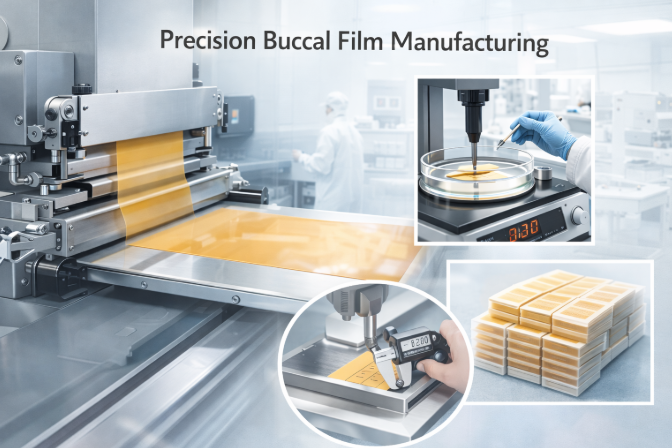
Manufacturing employed precision coating techniques capable of maintaining micron-level thickness control. Multi-zone drying systems were configured to regulate solvent evaporation rates, minimizing internal stress and ensuring uniform film morphology [4].
Dimensional Control and Cutting
Films were cut using high-accuracy die or laser systems to achieve consistent dimensions and dose uniformity. Registration accuracy was monitored to prevent edge defects and dosing variability during scale-up [5].
Measures
Thickness and Content Uniformity
Film thickness and active content were measured across production runs to evaluate spatial and batch-to-batch uniformity [6].
Adhesion and Mechanical Performance
Mucoadhesive strength, tensile properties, and flexibility were assessed to confirm functional performance during buccal application [7].
Process Repeatability
Key process parameters and deviation rates were tracked to assess manufacturing repeatability under continuous operation [8].
Results
Precision manufacturing processes achieved tight control of film thickness and content uniformity across scaled production volumes. Buccal films exhibited consistent adhesion behavior and mechanical stability, with minimal variation between batches. Controlled drying profiles significantly reduced defects such as curling, cracking, and non-uniform drug distribution.
Discussion
The results highlight that buccal film manufacturing requires a higher level of precision than rapidly dissolving oral films. Small deviations in process conditions can disproportionately affect product performance. Integrating formulation science with precision equipment and real-time process monitoring is therefore essential. This approach reduces reliance on post-production correction and enhances scalability for regulated applications [9].
Conclusion
Precision buccal film manufacturing is achievable through deliberate alignment of formulation design, high-resolution processing, and robust quality systems. By prioritizing precision at every stage of production, manufacturers can deliver buccal film products with reliable performance, regulatory readiness, and scalable supply potential. This precision-focused model supports the continued expansion of buccal films as a differentiated and clinically relevant delivery platform.
References
Shojaei AH. Buccal mucosa as a route for systemic drug delivery. J Pharm Pharm Sci. 1998;1(1):15–30.
Patel VF, Liu F, Brown MB. Advances in oral transmucosal drug delivery. J Control Release. 2011;153(2):106–116.
Preis M, Breitkreutz J. Buccal film formulation and manufacturing considerations. Expert Opin Drug Deliv. 2017;14(6):1–12.
Hoffmann EM et al. Manufacturing of oral and buccal films: Process considerations. Eur J Pharm Biopharm. 2011;78(3):447–455.
Cilurzo F et al. Cutting and handling effects on oral film uniformity. Eur J Pharm Biopharm. 2008;70(3):895–900.
European Pharmacopoeia. Uniformity of dosage units. EDQM, Strasbourg.
Smart JD. The basics and underlying mechanisms of mucoadhesion. Adv Drug Deliv Rev. 2005;57(11):1556–1568.
ICH Q8(R2). Pharmaceutical Development.
Morales JO, McConville JT. Manufacture and characterization of mucoadhesive oral films. Eur J Pharm Biopharm. 2011;77(2):187–199.
Previous:Advanced Buccal Film Delivery Technology
Next:No Information