Advanced Buccal Film Delivery Technology
Author: Sihan Meng, Leyu Zhu, Pengcheng Shi
Affiliation: RSBM
Email: pengchengshi@biotechrs.com; pcspc9@gmail.com
Abstract
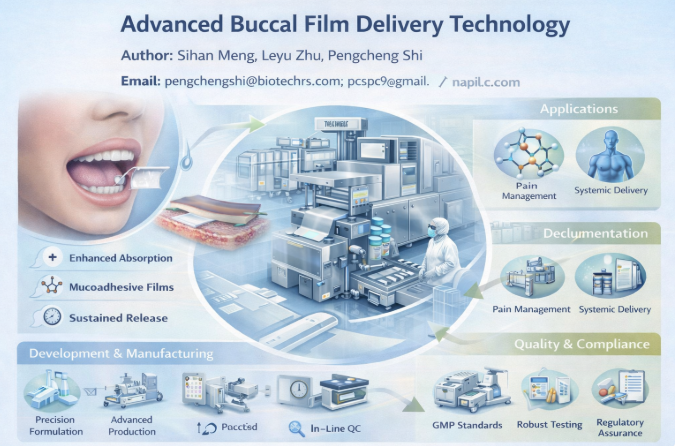
Buccal film delivery technology has emerged as an advanced oral drug delivery platform capable of providing rapid onset, improved bioavailability, and enhanced patient compliance. By enabling direct absorption through the buccal mucosa, buccal films partially bypass first-pass hepatic metabolism and gastrointestinal degradation. This paper reviews the scientific principles, formulation strategies, manufacturing considerations, and performance outcomes associated with advanced buccal film delivery systems. Emphasis is placed on technological innovations that support scalable manufacturing, consistent quality, and regulatory readiness for pharmaceutical and functional applications.
Keywords: Buccal film, oral mucosal delivery, bioavailability enhancement, fast onset, advanced drug delivery
Introduction
Oral mucosal drug delivery has gained increasing attention as an alternative to conventional oral administration routes. Among these approaches, buccal film delivery systems offer unique advantages, including rapid drug absorption, ease of administration, and avoidance of swallowing difficulties [1]. Buccal films adhere to the inner cheek, allowing sustained contact with the mucosa and controlled drug release.
Recent advances in polymer science and thin-film manufacturing have expanded the applicability of buccal films beyond niche indications. Today, buccal films are being explored for systemic delivery of small molecules, peptides, and functional compounds, positioning them as a next-generation oral delivery technology [2].
Methods
A comprehensive literature and technology review was conducted using peer-reviewed journals, pharmacopeial references, and regulatory guidance documents. Studies addressing buccal film formulation, manufacturing processes, and in vitro or in vivo performance were analyzed. Data were organized according to formulation composition, process parameters, and delivery outcomes, with emphasis on scalable and GMP-compatible approaches.
Measures
The performance of advanced buccal film delivery systems was evaluated using the following measures:
Mucoadhesive strength – ability of the film to adhere to buccal mucosa under simulated conditions [3].
Disintegration and residence time – balance between adhesion duration and patient comfort [4].
Drug release and permeation – in vitro dissolution and permeability across buccal tissue models [5].
Mechanical properties – tensile strength, flexibility, and folding endurance [6].
Content uniformity and stability – dose accuracy and resistance to moisture or chemical degradation [7].
Results
Published data indicate that advanced buccal films can achieve rapid initial drug release followed by sustained mucosal contact, resulting in improved systemic exposure compared with conventional oral dosage forms [5]. Polymer systems incorporating hydrophilic film-formers and mucoadhesive components demonstrate favorable adhesion and patient acceptability.
Manufacturing innovations, including controlled casting and precision drying, support uniform film thickness and reproducible performance. When aligned with formulation properties, these processes enable scalable production without compromising buccal adhesion or release characteristics [6].
Discussion
Advanced buccal film technology represents a convergence of formulation science and process engineering. The success of buccal delivery depends on optimizing the interplay between mucoadhesion, drug release, and mechanical integrity. Excessive adhesion may cause discomfort, while insufficient adhesion reduces bioavailability.
From a translational perspective, buccal films offer opportunities for differentiation in crowded therapeutic and wellness markets. However, challenges remain in taste masking, moisture sensitivity, and regulatory classification. Addressing these issues through integrated formulation and manufacturing strategies is critical for commercial success [7,8].
Conclusion
Advanced buccal film delivery technology provides a promising platform for efficient and patient-friendly oral mucosal drug delivery. By leveraging modern polymers, precise manufacturing, and GMP-aligned quality systems, buccal films can deliver consistent performance at scale. Continued innovation in formulation design and process control will further expand the role of buccal films in next-generation oral delivery systems.
References
Shojaei AH. Buccal mucosa as a route for systemic drug delivery: A review. J Pharm Pharm Sci. 1998;1(1):15–30.
Patel VF, Liu F, Brown MB. Advances in oral transmucosal drug delivery. J Control Release. 2011;153(2):106–116.
Smart JD. The basics and underlying mechanisms of mucoadhesion. Adv Drug Deliv Rev. 2005;57(11):1556–1568.
Morales JO, McConville JT. Manufacture and characterization of mucoadhesive buccal films. Eur J Pharm Biopharm. 2011;77(2):187–199.
Cilurzo F, Cupone IE, Minghetti P, Buratti S, Montanari L. Fast dissolving films: drug release and permeation aspects. Eur J Pharm Biopharm. 2010;76(1):93–101.
Preis M, Knop K, Breitkreutz J. Mechanical properties of oromucosal films. Int J Pharm. 2014;461(1–2):22–29.
Hoffmann EM, Breitenbach A, Breitkreutz J. Orodispersible and buccal films: formulation and regulatory considerations. Expert Opin Drug Deliv. 2011;8(3):299–316.
FDA. Guidance for Industry: Orally Disintegrating and Oromucosal Dosage Forms. U.S. Food and Drug Administration; 2008.