Drug Loading Enhancement Strategy: Key to Maintaining Film Formation at High Loading Levels
Author: Sihan Meng, Leyu Zhu, Pengcheng Shi
Affiliation: RSBM
Email: pengchengshi@biotechrs.com; pcspc9@gmail.com
Abstract
High drug loading is a persistent technical challenge in Oral Disintegrating Film (ODF) development. As loading levels increase, film-forming ability, mechanical integrity, dissolution performance, and process stability are often compromised, leading to cracking, poor uniformity, and scale-up failure. This paper systematically analyzes drug loading enhancement strategies for ODFs, focusing on how to maintain continuous film formation at elevated active ingredient concentrations. By examining material selection, formulation architecture, microstructure control, and process integration, this study provides a practical framework for achieving high-loading ODFs that remain manufacturable, consistent, and commercially viable.
Introduction
Oral Disintegrating Films are inherently low-mass dosage forms, which makes high drug loading particularly challenging compared with tablets or capsules. In ODFs, active ingredients must coexist within a thin polymer matrix that also serves as the mechanical backbone of the dosage form [1].
As drug loading increases, the polymer-to-drug ratio decreases, weakening chain entanglement, disrupting film continuity, and increasing brittleness or heterogeneity. Many ODF projects fail at the transition from low-dose prototypes to high-dose commercial targets due to insufficient understanding of loading–structure–process interactions [2]. This paper explores why high loading destabilizes film formation and presents strategies to overcome these limitations.
Methods
A formulation–process interaction analysis was conducted using peer-reviewed literature, polymer physics principles, and industrial ODF manufacturing experience. Drug loading strategies were evaluated in terms of their impact on film formation, mechanical properties, dissolution behavior, and process robustness. Emphasis was placed on scalable approaches applicable to continuous roll-to-roll production [3].
Drug Loading Constraints in ODFs
Structural Role of Polymers
In ODFs, film-forming polymers provide:
Mechanical strength
Flexibility
Matrix continuity
As drug loading increases, polymers transition from a continuous phase to a discontinuous binder phase, dramatically reducing film integrity [4].
Loading-Related Failure Modes
Common issues observed at high loading include:
Cracking during drying
Poor tensile strength
Active ingredient agglomeration
Non-uniform dissolution
Cutting and packaging failure
These failures reflect structural imbalance rather than simple formulation errors [5].
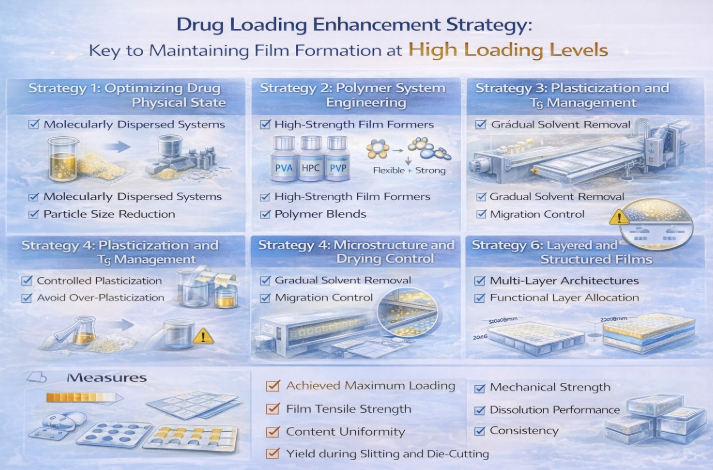
Strategy 1: Optimizing Drug Physical State
Molecularly Dispersed Systems
When feasible, dissolving the active ingredient within the polymer solution allows the polymer network to remain continuous, even at higher loadings.
Particle Size Reduction
For insoluble actives, micronization or nanonization reduces stress concentration points and improves film continuity [6].
Strategy 2: Polymer System Engineering
High-Strength Film Formers
Using polymers with stronger chain entanglement or higher intrinsic film strength allows greater tolerance for active loading.
Polymer Blends
Blending polymers (e.g., flexible + strong) improves stress distribution and maintains film formation at higher loadings than single-polymer systems [7].
Strategy 3: Plasticization and Tg Management
Controlled Plasticization
Plasticizers restore chain mobility lost due to high solid loading, lowering effective glass transition temperature (Tg) and preventing brittleness.
Avoiding Over-Plasticization
Excess plasticizer weakens films and destabilizes drying, requiring careful optimization [8].
Strategy 4: Microstructure and Drying Control
Gradual Solvent Removal
Controlled, multi-zone drying prevents rapid polymer immobilization that traps drug clusters and causes cracking.
Migration Control
Optimized drying profiles reduce active migration that becomes more pronounced at high loading levels [9].
Strategy 5: Layered and Structured Films
Multi-Layer Architectures
Separating structural and drug-loaded layers allows high drug content while preserving mechanical integrity.
Functional Layer Allocation
Structural layers maintain strength; drug layers focus on dose delivery, enabling higher overall loading [10].
Strategy 6: Area-Based Dose Optimization
Increasing Film Area
Instead of increasing concentration alone, dose can be increased by enlarging cut area while maintaining film-forming balance.
Thickness vs Loading Trade-Off
Moderate thickness increase is often more manageable than extreme concentration increases [11].
Measures
High-loading film success is evaluated using the following indicators [12,13]:
Maximum achievable loading (%)
Film tensile strength and elongation
Content uniformity at target dose
Dissolution performance
Yield during slitting and die-cutting
These measures reflect both structural integrity and manufacturability.
Results
Industrial experience shows that successful high-loading ODFs rely on combined strategies rather than single-variable optimization. Polymer system engineering and microstructure control are consistently more impactful than simply increasing polymer content. Layered designs and particle engineering significantly extend feasible loading limits without sacrificing yield or consistency [14].
Discussion
High drug loading challenges the fundamental balance between mechanical structure and functional delivery in ODFs. Attempting to “force” loading through concentration increases alone leads to brittle, unscalable films. In contrast, structural strategies that preserve polymer continuity allow higher loading while maintaining process robustness.
From a commercial perspective, high-loading capability expands the applicability of ODFs to new therapeutic and nutraceutical categories, but only when supported by disciplined formulation and process design [15].
Conclusion
Maintaining film formation at high drug loading levels requires a holistic strategy integrating drug physical state control, polymer system design, plasticization management, drying optimization, and structural architecture. High-loading ODFs are achievable not through brute-force formulation, but through engineered balance between structure and function. Manufacturers adopting these strategies can unlock higher-dose ODF products without sacrificing scalability or quality.
References
Fu Y et al. Expert Opin Drug Deliv. 2004;1(4):673–690.
Preis M. J Pharm Pharmacol. 2013;65(2):157–170.
Cilurzo F et al. Eur J Pharm Biopharm. 2008;70(3):895–900.
Sperling LH. Introduction to Physical Polymer Science. Wiley; 2005.
Dixit RP, Puthli SP. J Control Release. 2009;139(2):94–107.
Hoffmann EM et al. Pharm Res. 2011;28(8):1914–1922.
Bala R et al. Int J Pharm Investig. 2013;3(2):67–76.
Morales JO, McConville JT. Ther Deliv. 2011;2(5):637–646.
Kistler SF, Schweizer PM. Liquid Film Coating. Chapman & Hall; 1997.
Borges AF et al. Int J Pharm. 2015;494(1):332–339.
Preis M. Drug Dev Ind Pharm. 2013;39(7):1049–1057.
USP <905> Uniformity of Dosage Units.
USP <701> Disintegration Test.
Keshari R, Keshari S. J Drug Deliv Ther. 2014;4(4):1–7.
Arya A et al. Int J PharmTech Res. 2010;2(1):576–583.