Buccal Film vs ODF: Differences in Adhesion, Release, and Absorption Pathways
Buccal Film vs ODF: Differences in Adhesion, Release, and Absorption Pathways
Author: Sihan Meng, Leyu Zhu, Pengcheng Shi
Affiliation: RSBM
Email: pengchengshi@biotechrs.com; pcspc9@gmail.com
Abstract
Buccal films and Oral Disintegrating Films (ODFs/OTFs) are two closely related thin-film oral delivery systems that differ fundamentally in their adhesion behavior, drug release kinetics, and absorption pathways. While both leverage polymeric film matrices and solvent-based manufacturing, their clinical intent, formulation design, and performance outcomes diverge significantly. This paper provides a systematic comparison of buccal films and ODFs with a focus on adhesion mechanisms, release profiles, and absorption routes. By integrating formulation science, mucosal physiology, and manufacturing considerations, we clarify appropriate use cases for each platform and provide guidance for rational product selection and development across pharmaceutical, nutraceutical, and nicotine-delivery applications.
Introduction
Thin-film oral dosage forms have gained prominence as alternatives to conventional tablets and capsules due to improved patient compliance, rapid onset, and flexible dosing [1]. Within this category, buccal films and ODFs are often conflated, despite being designed for different therapeutic and functional objectives.
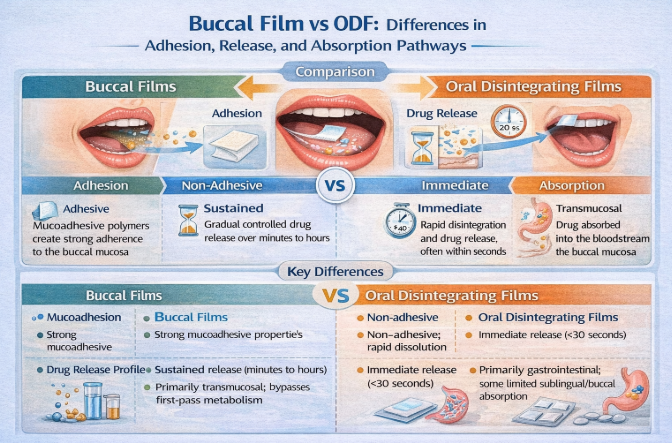
ODFs are intended to rapidly disintegrate in saliva, releasing actives that are swallowed and absorbed via the gastrointestinal tract, with optional partial transmucosal uptake [2]. Buccal films, in contrast, are designed to adhere to the buccal mucosa for prolonged residence, enabling controlled release and direct transmucosal absorption that bypasses first-pass metabolism [3]. Understanding these differences is essential for correct product positioning, formulation design, and regulatory strategy.
Methods
A comparative framework was developed based on peer-reviewed literature, pharmacopeial guidance, and industrial development experience. Buccal films and ODFs were evaluated across three primary dimensions: adhesion, release behavior, and absorption pathway. Secondary considerations included formulation composition, residence time, and manufacturing implications. Data were synthesized qualitatively to highlight functional distinctions and practical development consequences [4].
Adhesion Characteristics
Buccal Films
Buccal films are explicitly designed to adhere to the buccal mucosa through mucoadhesive interactions. These interactions arise from hydrogen bonding, electrostatic attraction, and polymer chain interpenetration with mucin [5].
Common mucoadhesive polymers include:
Carbomers
Polycarbophil
Chitosan
Hydroxypropyl cellulose (high-substitution grades)
Adhesion strength is a critical quality attribute, as premature detachment compromises dose delivery.
Oral Disintegrating Films
ODFs are intentionally non-adhesive or weakly adhesive. Their design prioritizes rapid wetting and disintegration rather than retention at a specific mucosal site [6]. Film-forming polymers such as pullulan and HPMC are selected for fast hydration and minimal mucoadhesion.
Drug Release Profiles
Buccal Films
Buccal films typically exhibit sustained or controlled release profiles. Drug diffusion occurs gradually from the hydrated polymer matrix into the mucosal surface over minutes to hours [7]. Release rate is governed by polymer viscosity, film thickness, and drug-polymer interactions.
Oral Disintegrating Films
ODFs are characterized by immediate or very rapid release, often within seconds. Upon contact with saliva, the film disintegrates, liberating the active ingredient almost instantaneously [8]. Release kinetics are dominated by disintegration rather than diffusion.
Absorption Pathways
Buccal Films
The primary absorption route for buccal films is transmucosal. Drugs permeate directly across the buccal epithelium into systemic circulation, partially or completely bypassing hepatic first-pass metabolism [9]. This pathway is advantageous for drugs with poor oral bioavailability or extensive first-pass degradation.
Oral Disintegrating Films
ODFs rely predominantly on gastrointestinal absorption following swallowing of the dissolved drug [10]. While limited sublingual or buccal absorption may occur for certain small, lipophilic molecules, this is generally not the primary design intent.
Measures
Key performance measures used to differentiate buccal films and ODFs include [11,12]:
Mucoadhesive strength and residence time
Disintegration time
In vitro release kinetics
Permeation studies across buccal tissue
Pharmacokinetic parameters (C_max, T_max, AUC)
These measures align product design with intended clinical outcomes.
Results
Comparative studies consistently demonstrate that buccal films provide prolonged residence time and sustained plasma levels, whereas ODFs deliver faster onset with shorter duration of action [13]. Buccal films show higher relative bioavailability for suitable actives due to first-pass avoidance, while ODFs excel in convenience, dosing simplicity, and consumer acceptance.
Discussion
The choice between buccal film and ODF platforms should be driven by therapeutic goals rather than manufacturing similarity. Buccal films are best suited for potent drugs requiring controlled delivery and metabolic bypass, but they demand precise adhesion control and patient education [14]. ODFs, by contrast, are optimized for rapid action, ease of use, and high-throughput manufacturing, making them attractive for supplements, OTC products, and nicotine delivery [15].
From a development perspective, buccal films impose stricter requirements on polymer selection, in vitro–in vivo correlation, and regulatory justification of adhesion and residence time. ODFs benefit from simpler clinical expectations but tighter control of disintegration and content uniformity.
Conclusion
Buccal films and Oral Disintegrating Films represent distinct oral thin-film technologies with fundamentally different adhesion behavior, release mechanisms, and absorption pathways. Buccal films emphasize mucoadhesion and transmucosal delivery, while ODFs prioritize rapid disintegration and gastrointestinal absorption. Clear differentiation between these platforms enables rational product design, reduces development risk, and ensures alignment between formulation strategy and clinical or consumer objectives.
References
Fu Y et al. Expert Opin Drug Deliv. 2004;1(4):673–690.
Preis M. J Pharm Pharmacol. 2013;65(2):157–170.
Shojaei AH. J Pharm Pharm Sci. 1998;1(1):15–30.
Cilurzo F et al. Eur J Pharm Biopharm. 2008;70(3):895–900.
Andrews GP et al. Eur J Pharm Biopharm. 2009;71(3):505–518.
Dixit RP, Puthli SP. J Control Release. 2009;139(2):94–107.
Morales JO, McConville JT. Ther Deliv. 2011;2(5):637–646.
Hoffmann EM et al. Pharm Res. 2011;28(8):1914–1922.
Smart JD. Adv Drug Deliv Rev. 2005;57(11):1556–1568.
Borges AF et al. Int J Pharm. 2015;494(1):332–339.
USP <701> Disintegration Test.
USP <905> Uniformity of Dosage Units.
Arya A et al. Int J PharmTech Res. 2010;2(1):576–583.
Keshari R, Keshari S. J Drug Deliv Ther. 2014;4(4):1–7.
Preis M et al. Drug Dev Ind Pharm. 2014;40(2):152–160.