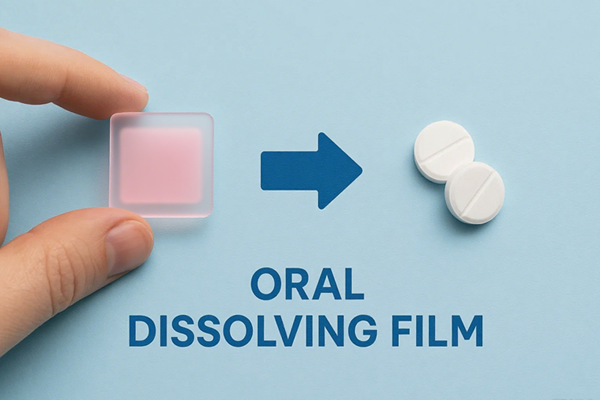
Oral Dissolving Film (ODF) Mechanism
Core pathway (4 steps)
Wetting & dissolution: Saliva spreads; hydrophilic matrices (HPMC/pullulan/PVA) swell and dissolve rapidly (target ≤10 s).
Release & solubilization: Actives diffuse out of the film; surfactants/cyclodextrins/solid dispersions plus flavor/buffer systems improve availability and comfort.
Transmucosal permeation: Absorption via sublingual/buccal mucosa into microcirculation (efficiency governed by pKa, logP, MW, local pH), partly reducing first-pass metabolism.
Swallowed supplement: Unabsorbed fraction is swallowed and absorbed GI-wise, creating dual-pathway exposure.
Efficiency drivers
Formulation: 50–120 μm thickness; salt/free-base & pH micro-environment; residual moisture/water activity; taste masking & mouthfeel.
Physiology: saliva volume, mucosal health, local blood flow.
Use: prefer sublingual/buccal placement; do not chew/swallow until fully dissolved.
How ODF differs from traditional forms
Direct mucosal access → faster perceived onset.
Unit dosing, no water, discreet portability.
Versus patches, ODF skews toward faster exposure with a shorter course.
Quality & packaging (B2B)
Release: dissolution time, dose uniformity (CV ≤ ±2–3%), thickness/GSM, residual moisture/water activity, sensory consistency.
In-process: inline thickness/weight/vision + data traceability (QbD/SPC).
Packaging: high-barrier four-side seal/blister; nitrogen/desiccant as needed; validate WVTR/OTR and logistics-humidity lanes.
Safety & compliance (informational)
Choose the appropriate regulatory path (dietary/medical device/drug) and label clearly; provide explicit guidance for children, pregnancy, and concomitant medications.