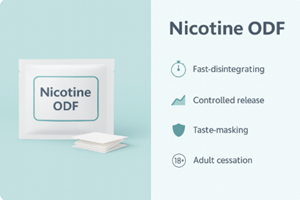
Introduction to Nicotine Oral Dissolving Films
A nicotine oral dissolving film is an ultra-thin edible strip designed to disintegrate on the tongue or buccal surface, delivering nicotine through the oral mucosa. Unlike combustible or device-based products, films are smokeless, ash-free, and largely odor-neutral, requiring no flame or battery. This makes them well-suited for discreet intake in shared indoor spaces, during commutes, and in other settings where smoking or vaping is restricted. Each strip is manufactured with a fixed dose, supporting precise tracking and control of daily intake.
Mechanistically, the film breaks apart in saliva within tens of seconds, releasing nicotine that diffuses across the mucosa and reaches systemic circulation while bypassing parts of gastrointestinal transit and first-pass metabolism. The result is a faster, more predictable perceived onset. Formulations typically use film-forming polymers such as HPMC, pullulan, or PVA with plasticizers like glycerin or PEG 400 to achieve flexibility, while sweeteners, flavors, and mild buffering reduce pungency and bitterness, yielding a clean, non-tacky, “melt-away” mouthfeel.
Compared with cigarettes or heated products, films avoid inhalation of combustion byproducts and minimize residual odors on clothing and interiors, eliminating the need for designated smoking areas. Versus gums or lozenges, films are thinner and more discreet, requiring no chewing and less dwell time—ideal for meetings, classrooms, flights, or any situation where a quick, low-profile option is preferred. Modern manufacturing pairs in-line thickness/appearance control with high-barrier unit packs to maintain content uniformity, disintegration time, and flavor stability over shelf life, supporting a steady day-to-day routine.
Use cases include transition management, focus-oriented tasks, and episodic cravings, with dose-stepping schemes enabling individualized day plans. That said, nicotine is addictive and not risk-free. Minors, pregnant or breastfeeding individuals, and people with relevant medical conditions should not use it; in highly regulated venues—such as aircraft cabins or hospitals—verify whether any nicotine product is permitted. Adult users should follow local laws, store safely, and keep products out of reach of children and pets.