Lab to Scale: Pilot Runs, PPQ, and Commercial Readiness for Buccal Films
Author: Sihan Meng,Leyu Zhu,Pengcheng Shi
Affiliation: RSBM
Email: pengchengshi@biotechrs.com; pcspc9@gmail.com
Abstract
Buccal films offer precise dosing, rapid onset, and improved patient adherence, but commercial success depends on more than laboratory feasibility. A structured pathway is required to translate bench-scale formulations into robust commercial processes. This paper outlines an integrated strategy from lab development through pilot runs and Process Performance Qualification (PPQ) to full commercial readiness for buccal films. We describe scale-up considerations for casting, drying, slitting, die-cutting, and packaging; define risk-based PPQ design; and propose practical metrics connecting critical quality attributes (CQAs) to process capability. Using representative case scenarios, we show how disciplined pilot campaigns and statistically sound PPQ reduce technical transfer failures, accelerate regulatory approval, and support confident product launches in diverse markets. [1–5]
Introduction
Buccal films are thin polymeric matrices applied to the buccal mucosa for systemic or local delivery. Compared with conventional tablets or liquids, they enable:
Bypass of first-pass metabolism (for suitable APIs),
Rapid or controlled release at the absorption site,
Use in populations with swallowing difficulties,
Differentiated IP and lifecycle management. [1,2]
However, buccal films are sensitive to:
Coating and drying conditions,
Moisture and temperature histories,
Cutting and handling forces,
Primary packaging barrier performance.
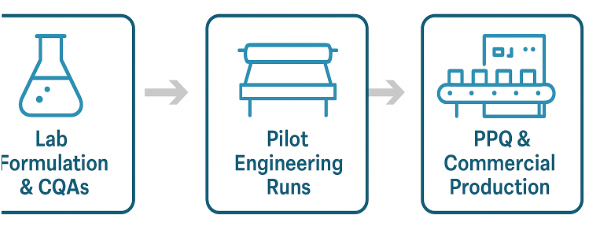
Many programs stall between lab success and commercial supply because scale-up and validation are approached reactively. This paper proposes a clear, “lab to scale” framework:
Robust development at lab scale.
Pilot engineering runs that represent commercial reality.
Well-designed PPQ demonstrating consistent performance.
Defined readiness criteria for launch and ongoing verification.
Methods
1. Lab-Scale Development
Key activities:
Selection of film-forming polymers, plasticizers, permeation enhancers, and API loading range.
Definition of CQAs:
Assay and content uniformity,
Thickness, tensile strength, flexibility,
Adhesion and residence time,
Disintegration/dissolution or release profile,
Microbial limits,
Organoleptic properties. [1]
Initial design space exploration:
Solid content, coating weight, casting speed,
Drying temperature and humidity.
Outputs: candidate formula(s), target thickness/weight per area, preliminary process parameters.
2. Pilot Runs (Engineering Batches)
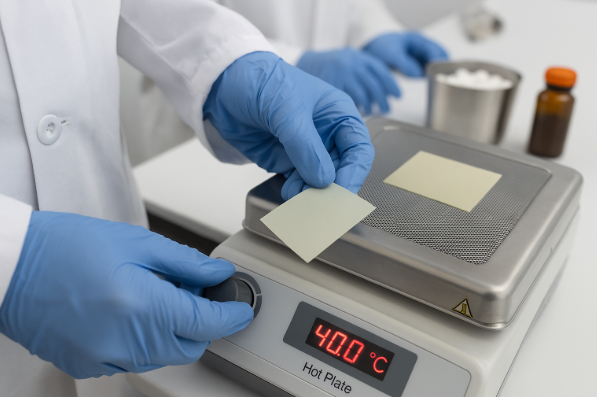
Pilot runs bridge R&D and commercial scale using:
A pilot coater or reduced-width commercial line using the same coating principle.
Pre-commercial slitting and die-cutting tools matching intended final geometry.
Representative primary packaging (e.g., PET/AL/PE sachets).
Activities:
Parameter Translation
Use dimensionless numbers (e.g., drying load per area, residence time) to scale from lab to pilot.
Design of Experiments (DoE)
Explore ranges for coating speed, gap, dryer zones, web tension.
Defect Mapping
Identify edge defects, air bubbles, non-uniformity, sticking, curl.
Stability “Snapshot”
Short-term studies to identify packaging and moisture sensitivity.
Outputs: refined process ranges, identified CPPs, refined control strategy.
3. PPQ Strategy
Process Performance Qualification is designed as:
A protocol-driven study confirming the commercial process, not a second R&D phase. [2–4]
Key elements:
Defined CPPs & CQAs
CPPs: solution viscosity, coating weight, dryer profile, web tension, cutting registration, seal parameters.
CQAs: assay, content uniformity, thickness, adhesion, residence time, impurities, microbiology, package integrity.
Number and Scope of PPQ Batches
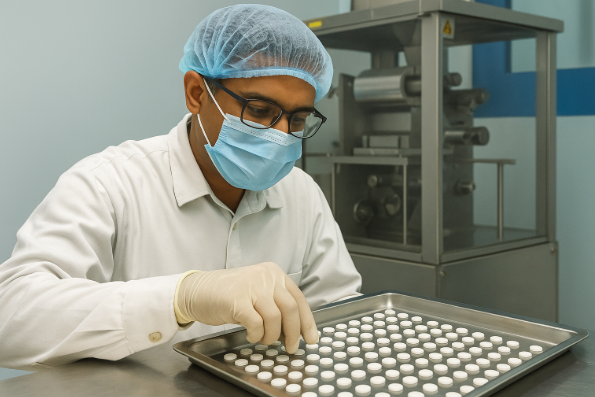
Typically 3 consecutive commercial-scale batches per strength and manufacturing train, or scientifically justified matrix.
Include normal variability in raw materials, line speed, and shift teams.
Enhanced Sampling
Stratified sampling across web width, roll length, and time (e.g., start/middle/end, multiple lanes).
Statistical Evaluation
Calculation of mean, SD, and capability indices (e.g., Cpk ≥ 1.33) for key CQAs.
4. Commercial Readiness Assessment
Parallel to PPQ:
Verification of cleaning validation, hold times, and line clearance.
Verification of computerized systems (eBR/MES, vision) relevant to buccal films.
Confirmation that stability data (including pilot and registration batches) support proposed shelf life. [3,5]
Formal readiness checklist: documentation, trained operators, qualified suppliers, change control in place.
Measures
Development & Scale-Up
Range of acceptable polymer/API loadings.
Thickness and coating weight variability at lab vs pilot.
Defect rates (bubbles, voids, edge flaws) per m².
PPQ Performance
Thickness,
Weight per unit area,
Adhesion and residence time.
Assay and content uniformity (% label claim; USP/Ph. Eur. criteria).
Cpk for:
% lots and samples meeting predefined specifications.
Process Robustness
Frequency of alarms, minor deviations, adjustments per batch.
Impact of deliberate small input variability (e.g., raw material lot, ambient conditions).
Commercial Readiness
Closure of all IQ/OQ and line-specific PQ.
Traceability completeness (materials → rolls → final packs).
Stability coverage for intended markets (ICH zones).
Results
1. Pilot Runs as a Filter
Well-structured pilot campaigns:
Reduced coating-related deviation risk at PPQ by identifying:
Critical dryer zones for residual moisture,
Sensitivity to web tension on adhesion and curl,
Optimal cutting registration tolerances.
Enabled early selection of suitable primary packaging for moisture-sensitive buccal films.
Programs that skipped robust pilot runs showed higher rates of PPQ rework and CAPAs.
2. PPQ Outcomes
For representative buccal film processes using the proposed strategy:
All three PPQ batches per product met:
Assay within 95–105%,
Tight content uniformity (e.g., AV well below regulatory limit),
Cpk ≥ 1.33 for thickness and weight per area,
Consistent adhesion and residence within target window.
Deviations during PPQ were limited to minor, well-documented events without impact on CQAs.
These data supported strong justifications for commercial process validation and set baselines for Continued Process Verification. [2–4]
3. Acceleration of Commercial Readiness
Compared with ad hoc approaches:
Time from final formula lock to PPQ completion was reduced, primarily due to:
Early alignment of CPPs from pilot runs.
Fewer unexpected behaviors at scale.
Regulatory queries related to process robustness and scale-up rationale were easier to address using:
DoE results,
PPQ statistics,
Clear link between lab, pilot, and commercial data.
Discussion
1. Importance of Mechanistic Understanding
Effective lab-to-scale transfer for buccal films depends on understanding:
How viscosity and solids content translate to coating weight.
How drying profiles influence residual solvent, mechanical strength, and adhesion.
How film properties respond to small variations in temperature, humidity, or speed.
Pilot runs and PPQ are not isolated checkboxes; they are checkpoints in a continuum of learning. [1,3]
2. Role of Risk-Based PPQ
Risk-based PPQ focuses on:
The parameters most likely to impact buccal performance:
Non-uniform thickness → dose variability,
Over-drying → brittle films,
Under-drying → microbial risk and sticking,
Mis-cutting → incorrect surface area.
Enhanced sampling where risk is highest (edges, start-up, lane transitions).
This aligns with modern guidance that PPQ should be science-driven, not a fixed “three batches because tradition” exercise. [2]
3. Integration with Quality Systems
Successful commercial readiness requires:
Completed and approved IQ/OQ/PQ for all relevant equipment.
eBR/MES integration so critical limits are enforced in routine production.
Stability program and packaging qualifications tightly coupled to PPQ findings.
Defined change-control routes for any post-launch adjustments.
Buccal film processes that formalize these links demonstrate higher reliability and fewer post-launch surprises.
4. Practical Guidance for Buccal Film Programs
Lock a small number of robust formulations early; avoid constant late changes.
Design pilot runs that mimic commercial equipment geometry and controls.
Use DoE outputs to set PPQ ranges; do not “guess tolerances.”
Predefine PPQ acceptance criteria and sampling plans in collaboration with QA/RA.
Treat PPQ data as the starting point of CPV: trend CQAs and CPPs from the first commercial lots.
Conclusion
For buccal films, “lab to scale” success hinges on a connected strategy:
Solid lab development that defines CQAs and preliminary design space.
Intentional pilot runs that translate understanding into scalable, stable processes.
Risk-based PPQ that statistically confirms performance under real-world conditions.
Integrated quality systems that support commercial manufacture and continuous verification.
By following this framework, organizations can reduce time-to-market, minimize validation failures, and launch buccal film products with confidence in both quality and regulatory robustness.
References
[1] Dixit RP, Puthli SP. Oral strip technology: overview and future potential. J Control Release. 2009.
[2] FDA. Process Validation: General Principles and Practices.
[3] ICH Q8(R2), Q9, Q10. Pharmaceutical Development; Quality Risk Management; Pharmaceutical Quality System.
[4] EMA & FDA buccal/transmucosal product assessment reports (various) – scale-up and validation expectations.
[5] ISPE. Baseline Guides and technical reports on scale-up and process validation.
[6] Industry case studies on pilot-to-commercial transfer for transmucosal films (anonymized).