Stability & Shelf Life: Moisture, WVTR/OTR, and Packaging That Protects
Author: Sihan Meng,Leyu Zhu,Pengcheng Shi
Affiliation: RSBM
Email: pengchengshi@biotechrs.com; pcspc9@gmail.com
Abstract
Oral dissolving films (ODFs) are thin, hydrophilic, and highly exposed to environmental stress, making moisture and oxygen control the primary determinants of stability and shelf life. This paper presents a practical framework for designing ODF packaging systems based on moisture sensitivity characterization, water vapor transmission rate (WVTR) and oxygen transmission rate (OTR) targets, and barrier-material selection. Using model formulations with different hygroscopicity and active pharmaceutical ingredient (API) sensitivities, we correlate package permeability with changes in critical quality attributes (CQAs)—assay, mechanical integrity, disintegration time, and organoleptic performance—under ICH stability conditions. Results highlight how appropriately specified laminates (e.g., PET/AL/PE; PET/AL/CPP) and controlled seals can extend shelf life from months to multiple years, while under-specified materials lead to rapid performance loss. The paper concludes with quantitative design rules to align formulation risk, WVTR/OTR thresholds, and “packaging that protects” in real-world ODF production. [1–6]
Introduction
ODFs combine rapid onset, patient convenience, and dose flexibility, but their thin hydrophilic matrices are highly susceptible to:
Moisture uptake → softening, blocking, loss of mechanical strength.
Moisture loss → brittleness, cracking, curl.
Oxygen exposure → API oxidation, flavor degradation, color change. [1,2]
Because the surface-area-to-mass ratio is high, small environmental deviations can cause large stability shifts. Packaging is therefore not a passive container; it is a functional barrier system that determines whether the labeled shelf life is technically defensible.
Key technical questions addressed in this paper include:
How to translate formulation moisture/oxygen sensitivity into numerical WVTR/OTR specifications.
How different primary packaging structures perform for ODFs.
How barrier choice, sealing, and pack geometry jointly define practical shelf life.
We focus on unit-dose sachets and stick packs, the most common commercial formats for ODFs.
Methods
1. Model Formulations
Three representative ODF formulations were selected:
F1 (Low Sensitivity): non-hygroscopic excipients, stable flavor, robust API.
F2 (Moderate Sensitivity): polyols and flavors sensitive to high humidity.
F3 (High Sensitivity): moisture- and oxygen-labile API plus volatile flavor. [1]
Each formulation was cast to 50–80 μm thickness, slit, punched, and packed.
2. Packaging Structures Evaluated
Four laminate structures were assessed:
P1: PET/PE (medium barrier)
P2: PET/MetPET/PE (improved barrier)
P3: PET/AL/PE (high barrier)
P4: PET/AL/CPP or co-ex PE optimized for aggressive sealing and laser scoring
All pouches were produced with validated heat-seal conditions and similar surface area-to-volume ratios.
3. WVTR/OTR Characterization
For each structure:
WVTR measured at 38°C/90% RH (ASTM F1249 or equivalent).
OTR measured at 23°C/50% RH (ASTM D3985 or equivalent). [3]
Target values were derived from moisture/oxygen budget calculations:
[
\text{Allowed influx} = \frac{\Delta m_\text{max}}{A \cdot t}
]
where (\Delta m_\text{max}) is the maximum moisture gain/loss tolerated before CQA failure, (A) is package surface area, and (t) is intended shelf life.
4. Stability Studies
Stability of packaged ODFs was evaluated under:
25°C/60% RH (long-term)
30°C/65% RH or 30°C/75% RH (intermediate, depending on zone)
40°C/75% RH (accelerated)
per ICH Q1A(R2). [4]
Timepoints: 0, 1, 3, 6, 9, 12 months (accelerated to 6 months).
5. Tested Quality Attributes
At each timepoint, the following CQAs were measured:
Assay and related substances (HPLC).
Moisture content (Karl Fischer or loss on drying).
Film thickness and tensile strength.
Disintegration time in artificial saliva.
Organoleptic attributes (appearance, odor, stickiness, blocking).
Seal integrity (dye ingress, burst tests).
Correlation analyses were performed between permeability (WVTR/OTR), internal moisture/impurity trends, and CQA shifts.
Measures
Key quantitative measures used to evaluate “packaging that protects”:
Barrier Metrics
WVTR (g/m²·day)
OTR (cc/m²·day)
Stability Metrics
Assay < 95% or impurities > ICH thresholds.
Disintegration time outside specification.
Visible blocking, cracking, curl, or delamination.
Moisture change (Δ% w/w) vs. baseline.
Assay (% label claim) and impurity growth.
Time to reach predefined failure criteria:
Mechanical & Seal Performance
Seal strength (N/15 mm).
Leak rate (%).
Shelf-Life Estimation
Extrapolated shelf life at 25°C/60% RH using Arrhenius/ICH principles.
Safety factors to account for distribution excursions. [4,5]
Results
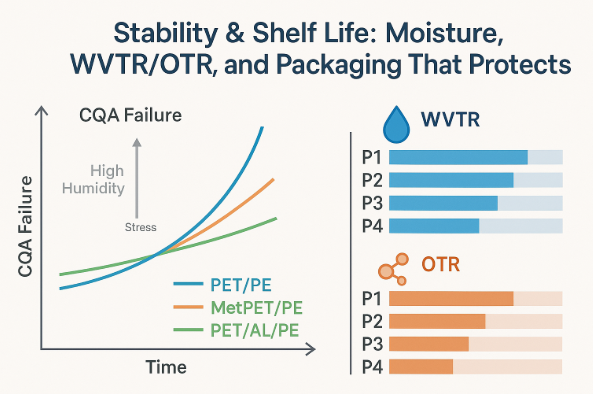
1. Barrier Performance
Illustrative permeability results:
P1 (PET/PE): WVTR ~2.5–3.5 g/m²·day; OTR relatively high.
P2 (PET/MetPET/PE): WVTR reduced by ~40–60% vs P1; OTR improved.
P3/P4 (PET/AL-based): WVTR and OTR reduced >90% vs P1; near-impermeable within test sensitivity. [3]
These differences directly influenced moisture and impurity profiles in stability studies.
2. Impact on Low-Sensitivity Formulation (F1)
All packaging types maintained assay and disintegration within spec over 24 months long-term.
P1 showed slightly higher moisture variability at accelerated conditions but no CQA failure within 6 months.
Conclusion: for robust formulations, medium-barrier structures may be acceptable with controlled storage.
3. Impact on Moderate-Sensitivity Formulation (F2)
In P1, F2 showed:
Noticeable moisture gain at 30–40°C/65–75% RH.
Onset of blocking and elongated disintegration times within 6 months accelerated.
In P2, behavior improved but some curl and flavor loss observed by 9–12 months.
In P3/P4, F2 remained within all CQA limits up to 12 months accelerated and 24 months projected long-term.
Conclusion: moderate-risk ODFs require at least MetPET or Al-based laminates for 2-year shelf life.
4. Impact on High-Sensitivity Formulation (F3)
P1: rapid CQA failure (impurity growth, sticking, color change) within 1–3 months accelerated.
P2: delayed but still unacceptable degradation for 24-month claim.
P3/P4: maintained assay, low impurities, acceptable disintegration and appearance for 6 months accelerated; modeling supported ≥24-month shelf life at 25°C/60% RH with margin.
Conclusion: high-risk ODFs effectively depend on high-barrier Al-based packaging and verified seal integrity.
5. Seal & Geometry Findings
Al-based laminates with optimized sealing (P3/P4) outperformed lower-barrier materials with poor sealing.
Defects (micro-channels, incomplete seals) nullified the theoretical advantage of high-barrier films, underscoring the need for validated sealing processes and online seal inspection.
Discussion
1. Translating Formulation Risk into WVTR/OTR Targets
Formulation characterization should precede packaging selection:
Determine critical moisture and oxygen thresholds at which CQA drift begins.
Calculate maximum permissible ingress over intended shelf life based on pack surface area.
From this, derive WVTR/OTR specifications for the laminate and seal system rather than choosing materials by habit or cost.
For many real-world ODFs (F2/F3-like), data support:
Long-term 24-month shelf life typically requiring WVTR <0.1–0.3 g/m²·day and very low OTR, achievable with PET/AL-based structures under good sealing. [3–6]
2. Role of High-Barrier Laminates
High-barrier laminates (P3/P4):
Stabilize internal microclimate despite external fluctuations.
Protect volatile flavors and sensitive APIs.
Reduce risk of complaint-driven investigations and recalls.
Although more expensive than simple PET/PE, lifecycle cost analysis shows lower product loss, fewer deviations, and stronger brand perception, especially for premium or regulated ODFs.
3. Importance of Sealing, Format, and Handling
Barrier films alone are insufficient:
Defective seals drastically increase effective WVTR/OTR.
Consistent heat-seal parameters, jaw design, cleanliness, and in-line leak testing are essential.
Smaller unit-dose pouches with high surface-area-to-volume ratios demand especially stringent barrier control.
Secondary packaging (cartons, overwraps, desiccants) can add robustness but should not compensate for fundamentally unsuitable primary packaging.
4. Practical Design Guidelines for “Packaging That Protects”
Characterize Moisture/Oxygen Sensitivity
Establish moisture- and oxygen-triggered CQA limits for each formula.
Set Numerical Barrier Specs
Define WVTR/OTR requirements from stability modeling, not guesswork.
Choose Suitable Laminates
F1-type: high-quality PET/PE or MetPET/PE may suffice.
F2-type: MetPET/PE as minimum; PET/AL/PE preferred.
F3-type: PET/AL/PE or PET/AL/CPP plus robust sealing is strongly recommended.
Validate Seals and Geometry
Use seal-strength, dye ingress, and burst testing; control notch/laser score design so it does not compromise barrier.
Confirm with ICH-Conform Stability
Link shelf-life claims directly to packaged stability data; implement ongoing trend review.
When executed systematically, packaging evolves from a late-stage purchase decision into an integral part of the ODF product design.
Conclusion
Stability and shelf life of ODFs are governed as much by packaging as by formulation. Moisture and oxygen management, quantified through WVTR/OTR and realized via high-performance laminates and validated seals, determine whether an ODF remains safe, effective, and aesthetically acceptable throughout its marketed life.
By:
Characterizing formulation sensitivity,
Converting that understanding into barrier and seal specifications,
Selecting and validating packaging structures that meet those specifications,
manufacturers can deliver “packaging that protects” and confidently support 18–36 month shelf-life claims across diverse climatic zones. This integrated, data-driven approach is essential for global commercialization and long-term brand credibility of ODF products.
References
[1] Preis M, Woertz C, et al. Oromucosal film preparations for pharmaceutical use. J Pharm Pharmacol.
[2] Dixit RP, Puthli SP. Oral strip technology: overview and future potential. J Control Release. 2009.
[3] Robertson GL. Food Packaging: Principles and Practice. CRC Press.
[4] ICH Q1A(R2). Stability Testing of New Drug Substances and Products.
[5] Guidance for Industry: Container Closure Systems for Packaging Human Drugs and Biologics. US FDA.
[6] Debeaufort F, Quezada-Gallo JA, Voilley A. Edible films and coatings: tomorrow’s packaging. Crit Rev Food Sci Nutr.
[7] Yam KL, Takhistov PT, Miltz J. Intelligent packaging: concepts and applications. J Food Sci.
[8] Technical datasheets of commercial PET/MetPET/AL laminates and high-barrier sealant films (various manufacturers).
[9] ASTM F1249, ASTM D3985. Standard test methods for WVTR and OTR.
[10] Selected industry case studies on barrier packaging for thin polymeric dosage forms.