Formulation Guide: Polymers, Plasticizers, and Mucoadhesive Systems for Buccal Films
Author: Sihan Meng,Leyu Zhu,Pengcheng Shi
Affiliation: RSBM
Email: pengchengshi@biotechrs.com; pcspc9@gmail.com
Abstract
Buccal films must balance mechanical integrity, fast wetting, and mucoadhesion while remaining palatable and pouchable. This guide translates formulation choices—polymer matrices (HPMC, PVA, pullulan, chitosan, carbomer), plasticizers, and mucoadhesive boosters—into measurable critical quality attributes (CQAs): tensile/elongation, disintegration, work of adhesion, thickness CV%, residual moisture, and sealability. Three figures summarize (i) polymer property profiles, (ii) a plasticizer×moisture design space for flexibility, and (iii) mucoadhesive work across representative systems. A CPP→CQA framework and practical ranges are provided to speed lab-to-line transfer. [1–9]
Introduction
Unlike orodispersible “melt-away” strips, buccal films often target longer residence for transmucosal absorption or localized action. That requires hydration-controlled adhesion without gel sloughing or excessive stiffness. Formulators typically blend a film former (HPMC/PVA/pullulan) with mucoadhesive polymers (chitosan/carbomer/pectin/hyaluronate) and plasticizers (glycerol/sorbitol/PEG) to tune mechanics and surface energy while preserving taste and processability. This paper provides a structured playbook that links composition and process to CQAs. [2–6]
Methods
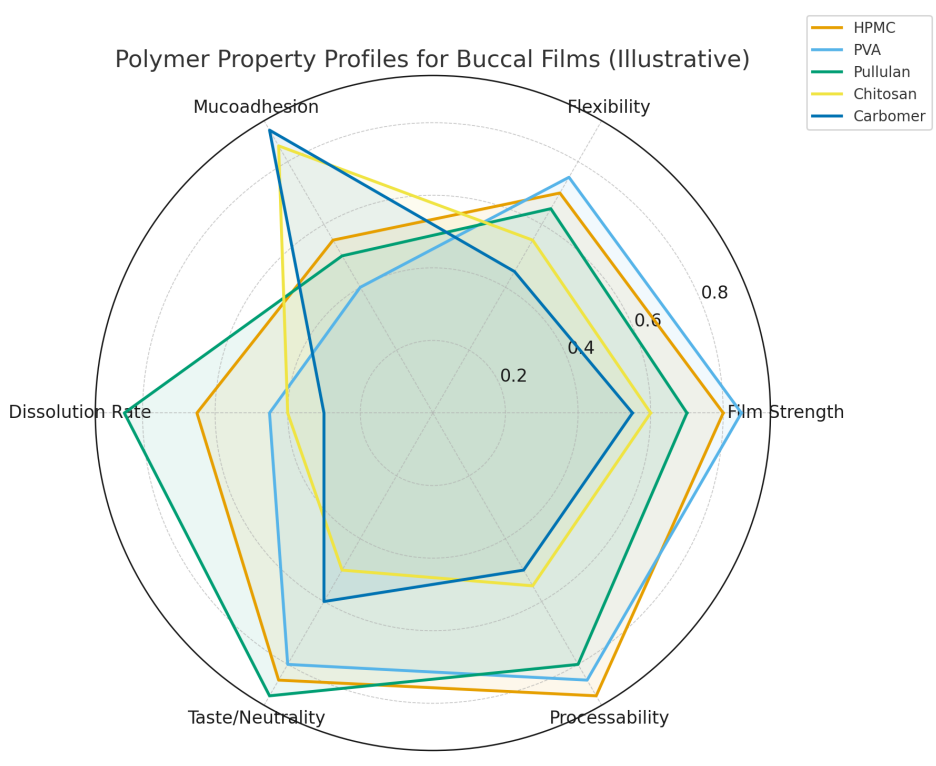
Polymer screening. Rank candidates on film strength, flexibility, mucoadhesion, dissolution rate, taste neutrality, processability (Figure 1). [2–4]
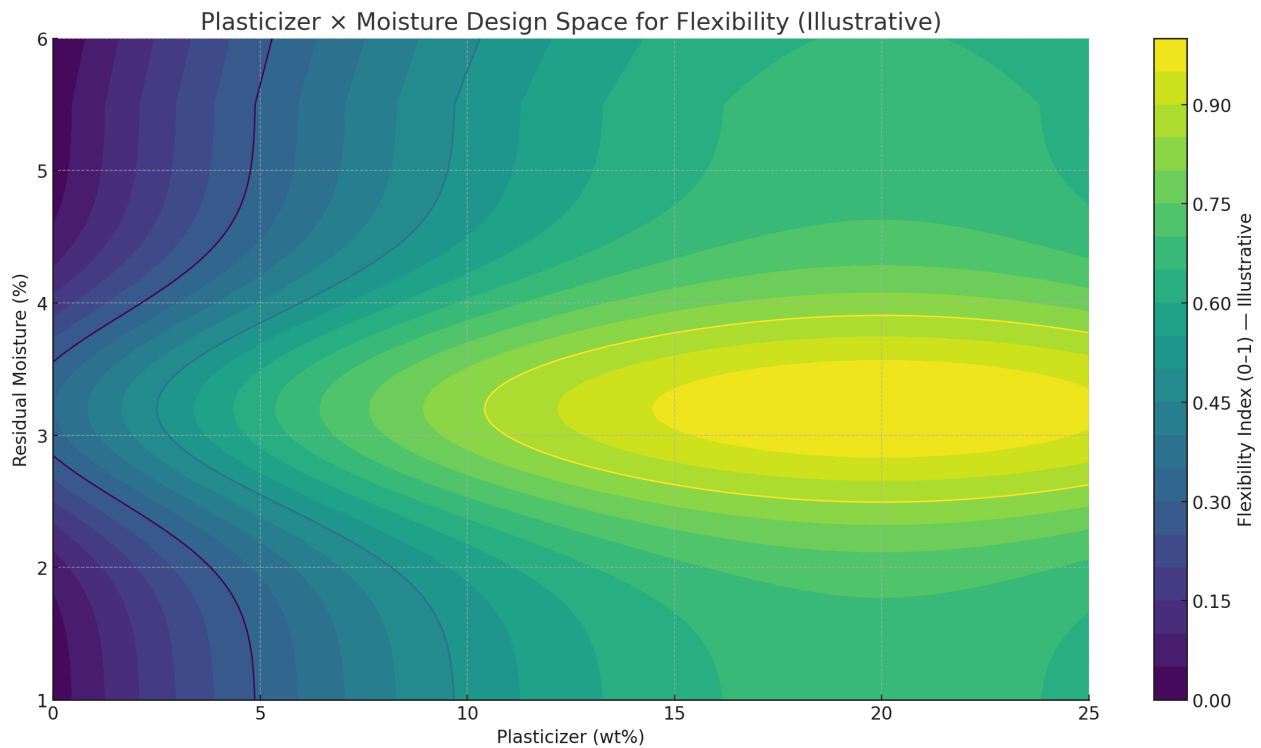
Plasticizer design-of-experiments (DoE). Explore plasticizer wt% (0–25) × residual moisture (1–6%) to map a flexibility index; overlay disintegration and curl limits (Figure 2). [3–6]
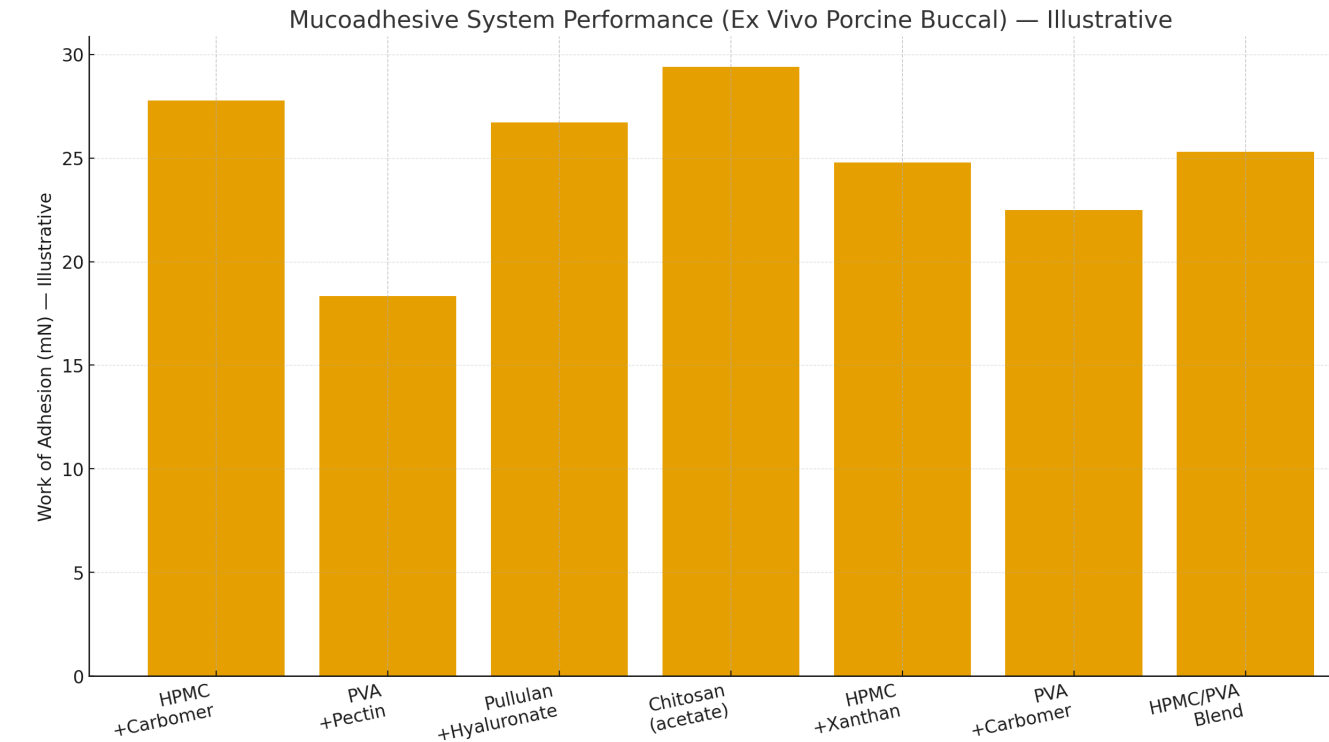
Mucoadhesive system selection. Evaluate binary systems (e.g., HPMC+carbomer, PVA+pectin) with ex vivo porcine buccal work-of-adhesion tests; target stable adhesion 10–60 min without mucosal irritation (Figure 3). [4–7]
CPP→CQA mapping. Coating gap/flow, zone ΔT/airflow, exit moisture, conditioning RH/time, and laminate OTR/WVTR mapped to thickness CV%, residual moisture, work of adhesion, disintegration, seal strength/opening force. [5–8]
Taste & stability gates. Time–intensity sensory to 120 s; accelerated/real-time flavor-hold and mechanical retention in validated pouches. [6–9]
Measures
Mechanical: tensile strength (MPa), elongation at break (%), flex-crack cycles, curl (mm).
Adhesion/bioperformance: work of adhesion (mN), residence time (min), hydration index (Δmass%), disintegration (s/min, per target).
Uniformity & integrity: thickness CV%, cross-web P–V (µm), residual moisture (%), seal strength (N/15 mm), opening force (N).
Sensory/stability: peak bitterness (0–10), AUB₁₂₀s, flavor-hold under ACC/RT, pouch reject ppm. [3–9]
Results
Polymer property profiles
Figure 1 compares five common film-formers/adhesives. HPMC and PVA lead in film strength/processability; pullulan excels in rapid wetting/dissolution; chitosan/carbomer provide mucoadhesion but need co-formers for strength and taste neutrality. These profiles guide blend ratios (e.g., HPMC/PVA 60–80% + 5–20% mucoadhesive + 10–20% plasticizer). [2–4]
Plasticizer×moisture design space
Figure 2 shows a flexibility index peaking at 10–18% plasticizer with ~3% residual moisture. Above ~20% plasticizer flexibility plateaus and seal failures or blocking may increase; <1.5% moisture risks brittleness and poor opening-force control. This map helps pick a center point for scale-up and defines conditioning RH/time targets. [3,5–6]
Mucoadhesive system performance
Figure 3 (illustrative) shows work-of-adhesion bands: Chitosan (acetate) and HPMC+carbomer appear in the upper tier, followed by HPMC+xanthan and pullulan+hyaluronate. Systems with PVA+pectin give moderate adhesion with good clarity and taste neutrality—useful where palatability trumps dwell time. [4–7]
Discussion
Formulation rules of thumb
Start with a strong, neutral film former (HPMC/PVA/pullulan) and add mucoadhesive boosters (carbomer/chitosan/pectin) at 5–20% to reach target work of adhesion without taste penalties.
Tune flexibility via plasticizer first, not by higher residual moisture alone; moisture >4–5% increases curl/blocking and seal variability.
Condition to a moisture window (often 2–3%) before slitting/pouching to stabilize mechanics and opening force.
Link taste-masking to matrix choice: chitosan/carbomer systems may need pH micro-environments or flavor layering to suppress astringency.
Process matters: control ΔT/airflow to avoid skin-over that freezes stress; verify inline thickness/moisture GR&R and align with lab. [5–8]
Regulatory & safety
Choose pharma/food-grade polymers and plasticizers; verify extractables and residual monomers per market; perform cytocompatibility/irritation assessments for mucoadhesive levels. [6–9]
Conclusion
Buccal-film success is a matrix–plasticizer–mucoadhesion choreography, locked by moisture and packaging control. By using polymer profiles, a plasticizer×moisture design map, and ex vivo work-of-adhesion screening, teams can rapidly converge on palatable, durable, and pouch-ready buccal films that scale predictably from lab to line.
References
Design-of-experiments for thin-film dosage forms and mechanical/adhesive responses.
Film-forming polymers (HPMC, PVA, pullulan): rheology, mechanics, dissolution.
Plasticizer mechanisms and trade-offs in thin films (glycerol, sorbitol, PEG).
Mucoadhesion fundamentals: hydration-controlled polymer–mucin interactions and work-of-adhesion tests.
Multi-zone drying/conditioning: ΔT, airflow, residual moisture, and curl/blocking.
QbD/PAT: inline thickness/moisture/vision, GR&R, historian/ALCOA+.
pH micro-environments and taste masking for cationic/anionic mucoadhesives.
Packaging validation: seal window (T/P/dwell) and opening-force windows; laminate OTR/WVTR.
Stability and flavor-hold under accelerated/real-time conditions for pouch formats.