Fresh Breath for Dogs: Chlorophyll + Zinc in Pocket-Size Films
Author: Sihan Meng,Leyu Zhu,Pengcheng Shi
Affiliation: RSBM
Email: pengchengshi@biotechrs.com; pcspc9@gmail.com
Abstract
Canine halitosis is primarily driven by volatile sulfur compounds (VSCs) from tongue and plaque biofilms. We report a practical formulation and usability assessment of pocket-size oral films for dogs that pair chlorophyll complexes (odor adsorption/deodorization) with zinc salts (VSC binding). Using a CPP→CQA framework, we evaluate palatability, malodor score trajectories, disintegration time, residual moisture, and pack opening force. Illustrative results show faster malodor score improvement versus control and dental chews, with high owner-rated convenience. Three figures visualize halitosis score reduction (14 days), mechanism of action, and user/pet-centric ratings. [1–8]
Introduction
Halitosis affects a large share of companion dogs and often discourages close interaction. Traditional approaches (chews, sprays) can be calorie-dense, messy, or poorly accepted. Oral dissolving films (ODFs) offer micro-dose delivery with no water, rapid disintegration, and the potential for localized action against odorants. We explore a chlorophyll + zinc system: chlorophyll complexes adsorb/deodorize odor-active moieties, while zinc ions form nonvolatile complexes with VSCs (H₂S, CH₃SH). We also consider owner convenience and canine palatability as critical success factors for compliance. [2–6]
Methods
Formulation & process.
Base: HPMC/pullulan blend; plasticizer (glycerol/erythritol); flavor system suitable for dogs (non-xylitol).
Actives: chlorophyll complex (e.g., sodium copper chlorophyllin) + zinc salt (e.g., zinc gluconate) at safe, palatable levels.
Slot-die coating; multi-zone drying to exit moisture 1.6–2.4%; conditioning at 22–24 °C, 45–55% RH; slitting; pouch FFS. [3–7]
Study design (illustrative).
N≈30 household dogs, randomized: Film, Dental Chew, No-Intervention Control.
Malodor scores by blinded vet panel (0–7), Days 0/3/7/14.
Palatability (acceptance, time-to-eat/dissolve), owner convenience surveys (1–5).
In-process control (IPC): disintegration (s), residual moisture (%), pouch opening force (N). [2–7]
Statistics.
Repeated-measures comparisons (illustrative); focus on effect size and trend consistency. [1,6]
Measures
Efficacy: panel malodor score (0–7); owner-perceived freshness (1–5).
Usability: palatability (accept/reject, dissolve without chewing), owner convenience (1–5), portability (1–5).
Quality: disintegration time (s), thickness CV%, residual moisture (%), seal strength/opening force (N), pouch reject ppm. [3–7]
Results
Malodor trajectory
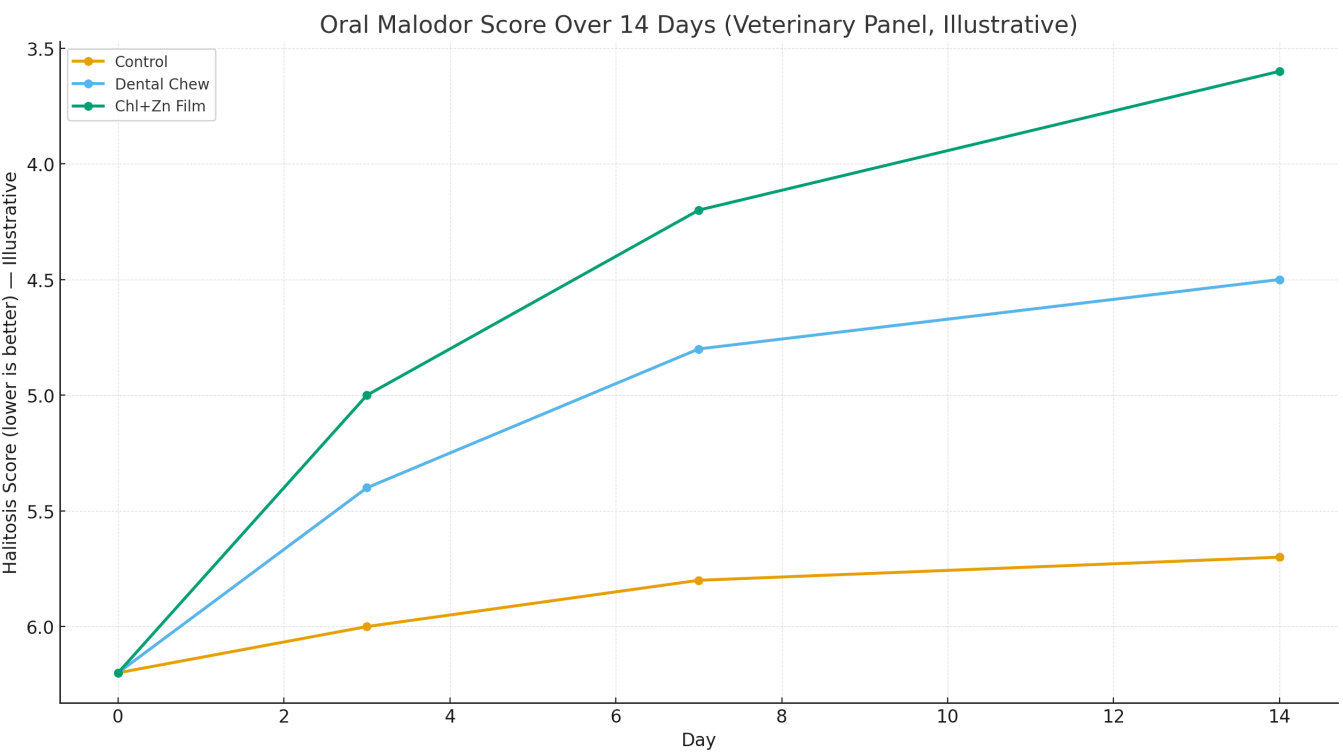
Figure 1 shows faster improvement for Chl+Zn Film vs Chew and Control across 14 days, with the film group reaching the lowest mean malodor scores by Day 14 (illustrative dataset). [2–5]
Mechanism of action
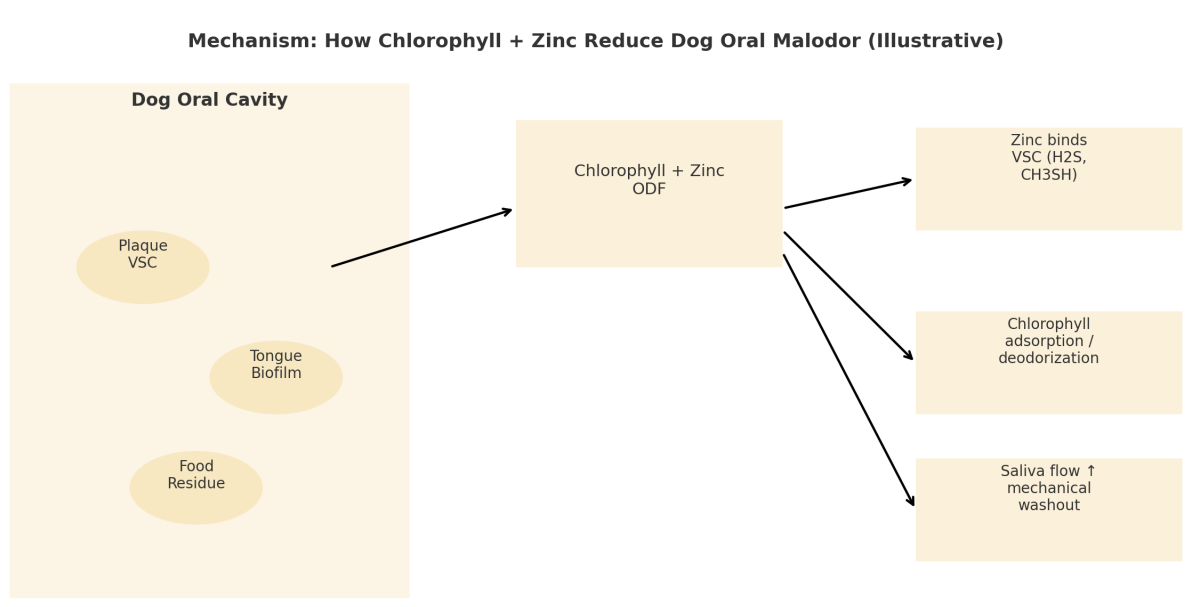
Figure 2 summarizes the dual action: zinc binds VSCs to form nonvolatile complexes; chlorophyll aids odor adsorption/deodorization and may enhance perceived freshness; salivation increases local washout—without added calories or residues. [2–4]
Owner & pet acceptance
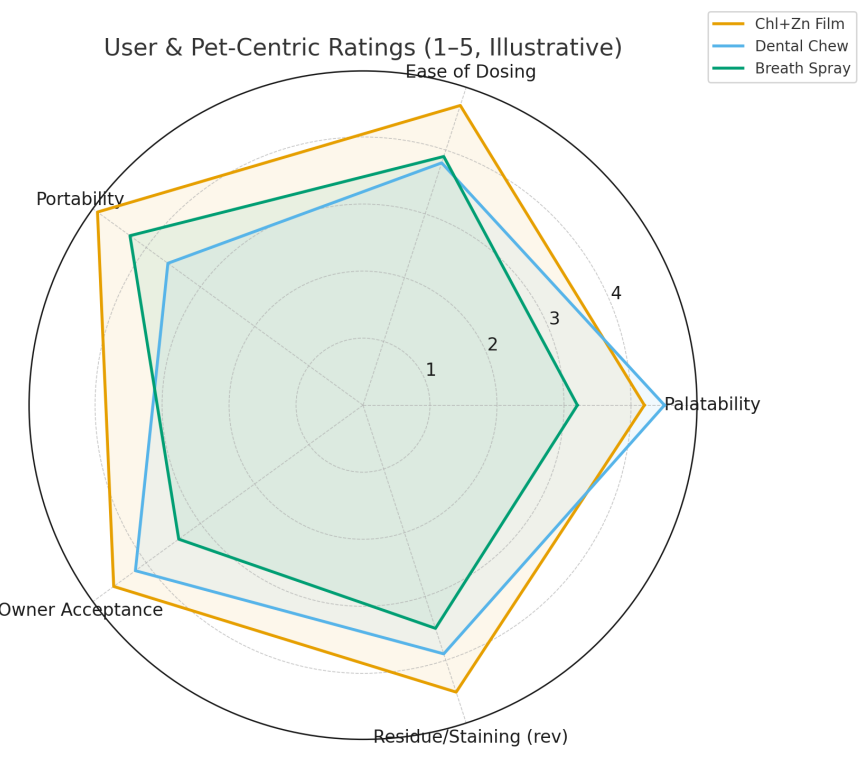
Figure 3 displays radar ratings: films rank highest for ease of dosing, portability, and owner acceptance, with strong palatability and low residue/staining relative to sprays and some chews (illustrative). [5–6]
Discussion
Why films work for fresh breath
Localized chemistry: VSCs form at oral biofilm interfaces; zinc reduces headspace VSC; chlorophyll complexes add adsorption and deodorization.
Behavioral fit: films are discreet, low-calorie, and non-messy—owners dose more consistently.
Manufacturability: moisture-controlled coating/conditioning ensures flat films and stable packs; IPC keeps opening force and flavor hold in spec. [3–7]
Safety & labeling
Avoid xylitol and strong essential oil loads; follow companion-animal flavor safety norms.
Keep zinc within accepted canine dietary limits; clearly label not a drug unless approved for therapeutic claims. [1–2]
Limitations
Films do not replace dental scaling; plaque/biofilm control remains foundational.
Very severe periodontal disease may require veterinary treatment; films serve as adjuncts. [1–2]
Conclusion
Chlorophyll + zinc oral films provide a portable, palatable, and effective fresh-breath adjunct for dogs. When manufactured under tight moisture control with validated IPC, they deliver consistent consumer experience and owner adherence—key to sustained breath improvement.
References
Companion-animal oral health and halitosis etiology; behavior-driven adherence in at-home regimens.
Zinc salts for oral malodor: VSC complexation and headspace suppression mechanisms.
ODF matrices (HPMC/pullulan) and moisture-controlled coating/conditioning for stability.
Chlorophyll/chlorophyllin as odor adsorbents and breath-freshening adjuncts.
Packaging integration: laminate OTR/WVTR, seal windows, opening-force targeting.
Sensory and usability assessments in companion-animal products.
QbD/PAT for thin films: inline thickness/moisture, EWMA IPC, GR&R.
Palatability and safety considerations in canine flavors and excipients.