Core of Oral Dissolving Film Formulation: How to Define Film Performance with HPMC/PVA/Pullulan Polymers
Author: Sihan Meng,Leyu Zhu,Pengcheng Shi
Affiliation: RSBM
Email: pengchengshi@biotechrs.com; pcspc9@gmail.com
Abstract
Hydroxypropyl methylcellulose (HPMC), polyvinyl alcohol (PVA), and pullulan are three foundational film-forming polymers for oral dissolving films (ODFs). Each polymer encodes distinct structure–property behaviors—glass transition, water affinity, mechanical strength, oxygen barrier, and dissolution kinetics—that govern critical quality attributes (CQAs) such as thickness uniformity, tensile performance, disintegration time, residual moisture, and drug release. This paper defines a practical, measurement-driven framework for polymer selection and binary blending (HPMC–pullulan), with PVA as a strength/clarity benchmark, to engineer tunable ODF performance. Using illustrative figures (polymer property comparison, composition–disintegration heatmap, and dissolution profiles), we show how polymer ratios and plasticizer loading translate into measurable CQAs and robust validated performance windows (VPWs) for scale-up. [1–6]
Keywords
ODF; HPMC; PVA; pullulan; plasticizer; dissolution; disintegration; QbD; PAT; film mechanics
Introduction
ODFs rely on hydrophilic polymer matrices to create fast-dissolving, mechanically sound films that carry APIs, flavors, and functional excipients. HPMC offers balanced filmability and process robustness; PVA provides high tensile strength and clarity with slower hydration; pullulan delivers excellent oxygen barrier and rapid disintegration with crisp mouthfeel. Formulation success depends on matching polymer physics to CQA targets and manufacturing realities (coating rheology, drying, and packaging). A structured approach is needed to define polymer-driven performance and avoid late-stage rework. [1–4]
Methods
Polymer screening. Prepare benchmark films (e.g., 50–70 µm dry) with fixed plasticizer (glycerol/sorbitol 10–15% w/w polymer) and constant solids for comparable coat weight.
Binary blending. Create HPMC–pullulan blends (e.g., 0–100% HPMC in the HPMC+pullulan fraction) to map disintegration and mechanics at constant plasticizer.
Mechanical testing. Measure tensile strength (MPa), elongation (%), and Young’s modulus; perform puncture resistance for handling robustness. [1–2]
Disintegration & dissolution. Use a standardized in vitro mouth model (37 °C, minimal volume) for disintegration time; conduct USP-compliant dissolution for model APIs. [3–4]
Moisture & barrier. Determine residual moisture (LOD/Karl Fischer), water activity (aw), and OTR/WVTR on packaged units; track curl and dimensional stability across RH steps. [5]
Process alignment. Validate coatability (viscosity–shear curves), drying windows (zone ΔT/airflow), and packaging pass rates (easy-open, seal strength) to ensure VPW continuity. [4–6]
Measures
Film mechanics: tensile (MPa), elongation (%), modulus (MPa), puncture force (N).
Disintegration: target time (e.g., 30–90 s) under defined saliva simulant and agitation.
Dissolution: t50, t80, and f2 (similarity factor) vs reference profile.
Moisture/barrier: residual moisture (%), aw, OTR/WVTR (pack-level), curl index.
Processability: wet viscosity at shear rates relevant to slot-die/comma coating; drying residence time at target speed; defect counts (streaks, pinholes) per 100 m. [4–6]
Results
Polymer Baselines
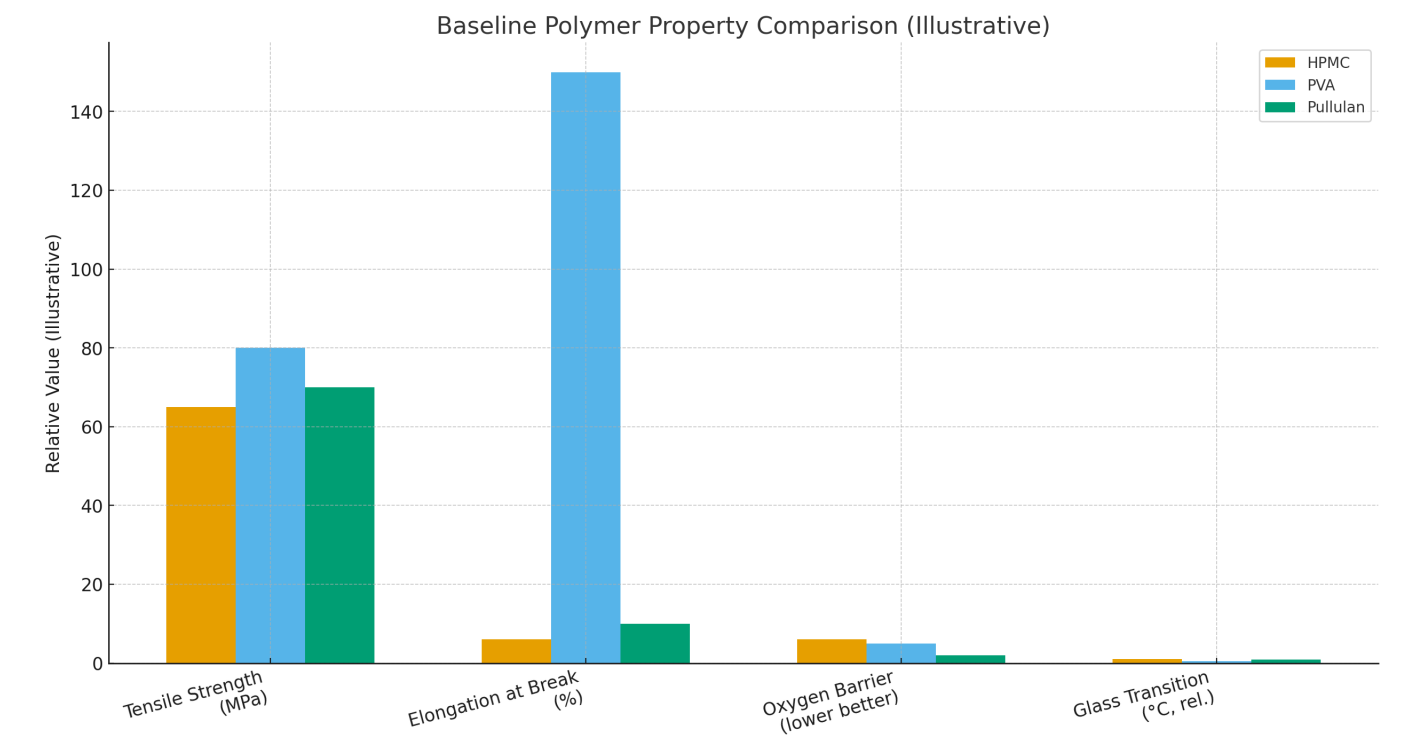
Figure 1 (illustrative) compares normalized properties. PVA exhibits the highest tensile strength and elongation (toughness) with moderate oxygen barrier; HPMC is balanced but stiffer (lower elongation) and reliable in coating; pullulan shows strong oxygen barrier and fast wetting/disintegration with moderate strength. These tendencies guide initial design: PVA for handling robustness, pullulan for rapid disintegration, and HPMC as a tunable backbone. [1–3]
Composition–Disintegration Relationship
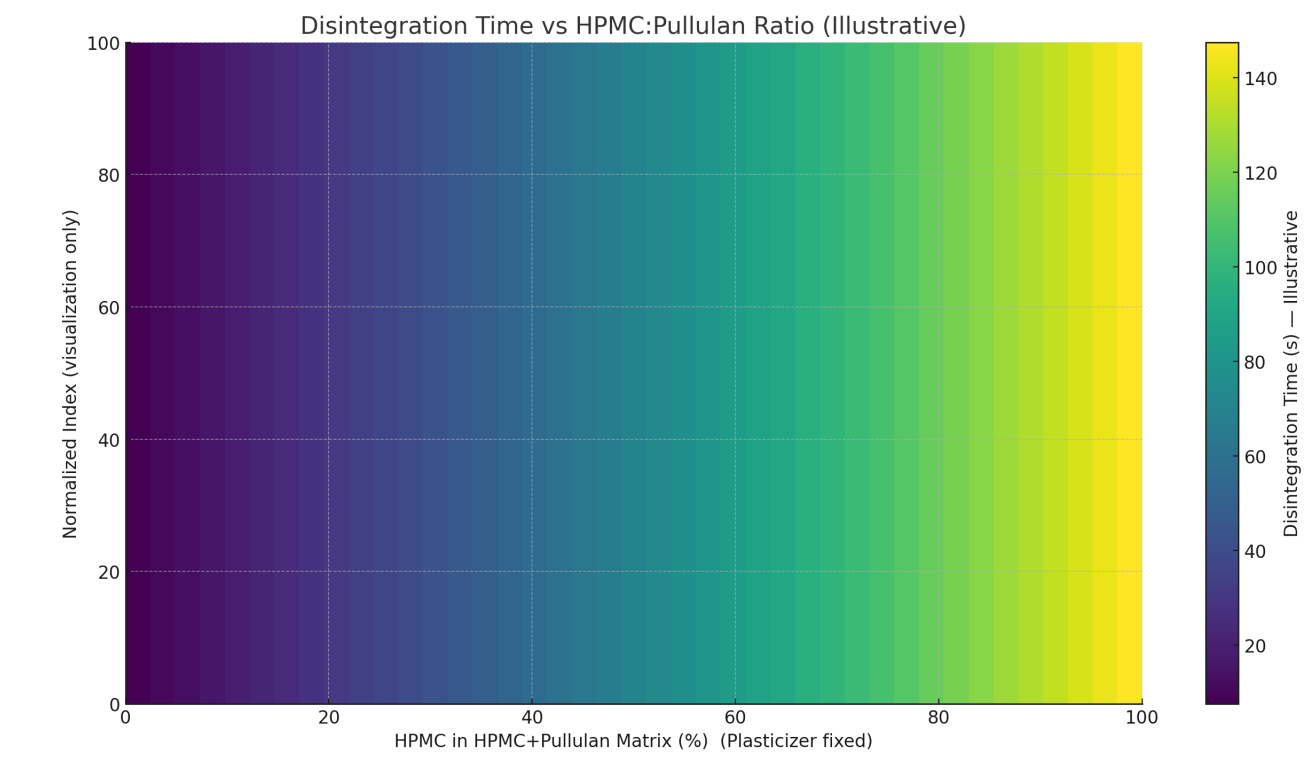
Figure 2 models disintegration time vs HPMC:pullulan ratio at fixed plasticizer. Increasing pullulan generally decreases disintegration time until plasticizer saturation or surface gelation plateaus the benefit; excess HPMC slows disintegration but can stabilize mechanics and flavor systems. The practical minimum must still respect taste-masking and API release goals. [3–5]
Dissolution Profiles
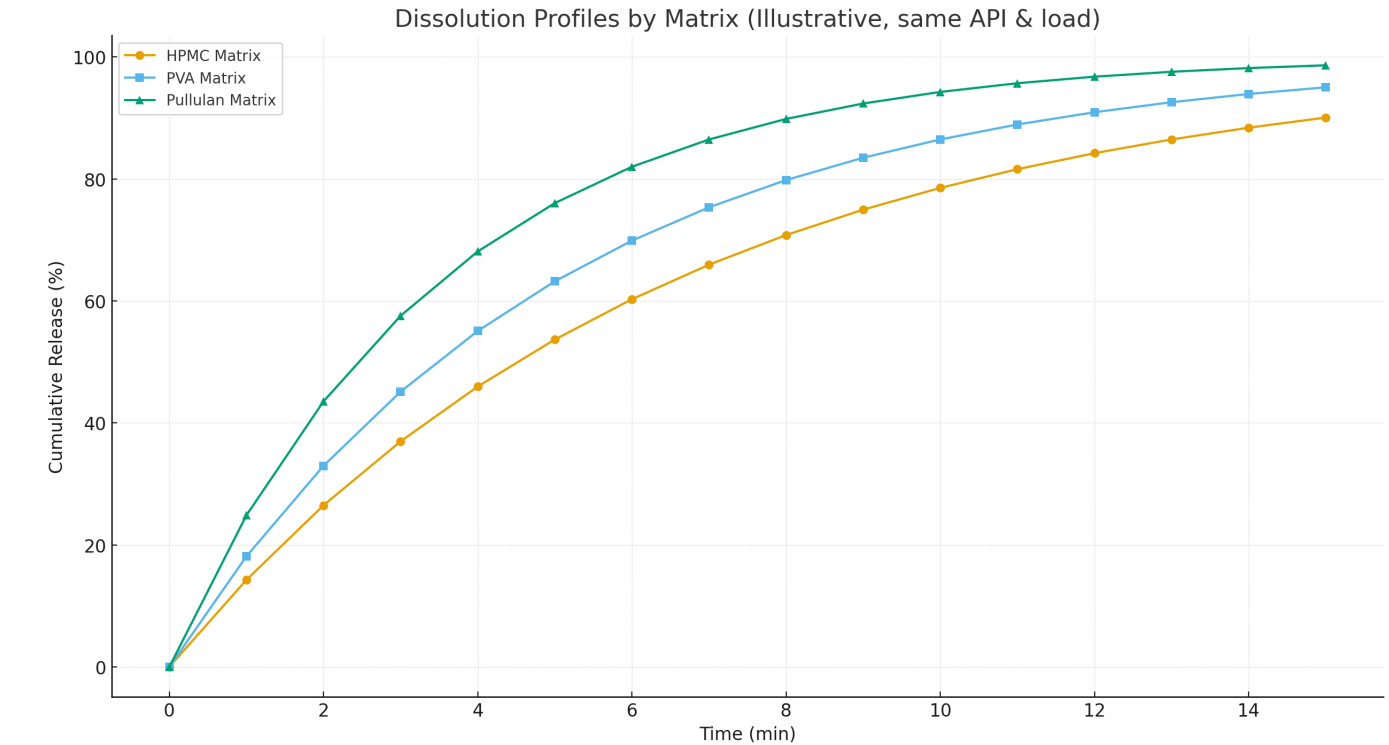
Figure 3 shows illustrative dissolution curves for a model API at the same load: pullulan matrices release fastest (rapid wetting), PVA is slower (denser gel layer), and HPMC is intermediate with profile tunability via substitution grade and plasticizer. These kinetics can be exploited for sensory timing (mint burst vs sustained cool) or for actives needing a defined dissolution ramp. [2–4]
Discussion
1) Polymer physics to CQAs.
HPMC: cellulose ether with tunable substitution → reliable coating rheology, good film integrity, disintegration controllable with plasticizer and grade.
PVA: semicrystalline hydrogen-bonded network → high toughness and clarity; hydration-driven gel layer slows disintegration and release.
Pullulan: amorphous α-(1→6)-linked maltotriose polymer → superior oxygen barrier, rapid water uptake, crisp mouthfeel; sensitive to moisture-induced brittleness without balanced plasticizer. [1–3]
2) Plasticizer synergy. Within 8–18% w/w polymer, polyols lower Tg and improve elongation, but over-plasticization accelerates moisture pickup, raises curl risk, and can slow apparent disintegration by surface softening without full breakup. Use DOE to optimize level/type (glycerol, sorbitol, xylitol). [2–3,5]
3) Blending strategy (HPMC–Pullulan).
Fast-dissolving sensory SKUs: Pullulan-rich (≤30–40% HPMC) with 10–12% plasticizer; monitor brittleness at low RH.
Balanced ODFs (taste-masked actives): Mid-blend (40–70% HPMC) to stabilize handling and reduce edge cracking; add saliva-triggered disintegrants if needed.
High-strength needs (large format, high-speed packaging): Consider PVA-containing systems or HPMC-rich blends; verify easy-tear sachet compatibility to avoid consumer complaints. [3–5]
4) Process integration.
Coating: Keep viscosity in the 300–1500 mPa·s range (shear-rate matched) for slot-die/comma; manage surface tension for bead stability.
Drying: Stage ΔT/airflow to avoid skinning; measure exit residuals and curl; match to packaging line to maintain pass rate.
Packaging: Select high-barrier laminates for pullulan-heavy films; qualify easy-tear vs easy-peel structures at target RH to minimize opening force variability. [4–6]
Conclusion
HPMC, PVA, and pullulan provide complementary levers for defining ODF performance. By anchoring design to measurable CQAs—mechanics, disintegration, dissolution, and moisture/barrier—and by mapping polymer ratios and plasticizer levels to a validated performance window, teams can scale formulations with fewer surprises. Blending HPMC–pullulan achieves rapid disintegration with controllable strength, while PVA or HPMC-rich systems serve high-robustness or taste-masked applications. Integrating formulation with coating/drying windows and packaging barrier ensures end-to-end quality.
References
Overview of film-forming polymers (cellulose ethers, PVA, pullulan) and structure–property relationships in oral films—review articles.
Plasticization of hydrophilic films: effects of polyols on Tg, mechanics, and moisture uptake—materials science studies.
Disintegration and dissolution of fast films: impact of polymer composition, grade, and saliva simulants—pharmaceutical technology literature.
Coating rheology and drying windows for thin films: slot-die/comma process fundamentals and defect avoidance.
Moisture management and packaging barrier (OTR/WVTR) for hydrophilic films; curl mitigation strategies across RH cycles.
QbD frameworks for ODFs: linking polymer selection and plasticizer level to CQAs, PAT selection, and scale-up readiness.