The Ingenious Design of Oral Film Protective Packaging
The Ingenious Design of Oral Film Protective Packaging
Author: ZHULEYU (RSBM)
Abstract
Oral dissolving films (ODFs) demand packaging that protects against moisture and oxygen, preserves flavor and mechanical integrity, and opens easily without compromising seal security. This paper proposes a design framework integrating barrier selection, seal geometry, easy-open features, nitrogen flushing, and in-process controls. We visualise the barrier landscape for common laminates, quantify easy-open versus child-resistance with opening-force distributions, and prioritise risks using a packaging FMEA heatmap. The framework ties ASTM barrier metrics (WVTR/OTR) and seal strength to ODF critical quality attributes (CQAs)—a_w, residual O₂, taste hold, curl—and shows how thoughtful laminate choice and notch design reduce failure modes and user frustration while maintaining GMP readiness [1–7].
Introduction
Packaging is the silent half of an ODF product. Thin, hygroscopic films lose performance when a_w creeps upward; oxygen accelerates flavor rollback and some API degradation; poor opening experiences erode adherence. Ingenious packaging reconciles barrier, convertibility, and usability: foil laminates or metallised structures for low WVTR/OTR; robust but peelable seals; user-friendly tears that avoid channel leaks; and process controls that lock the pack’s micro-environment [2–6].
Methods
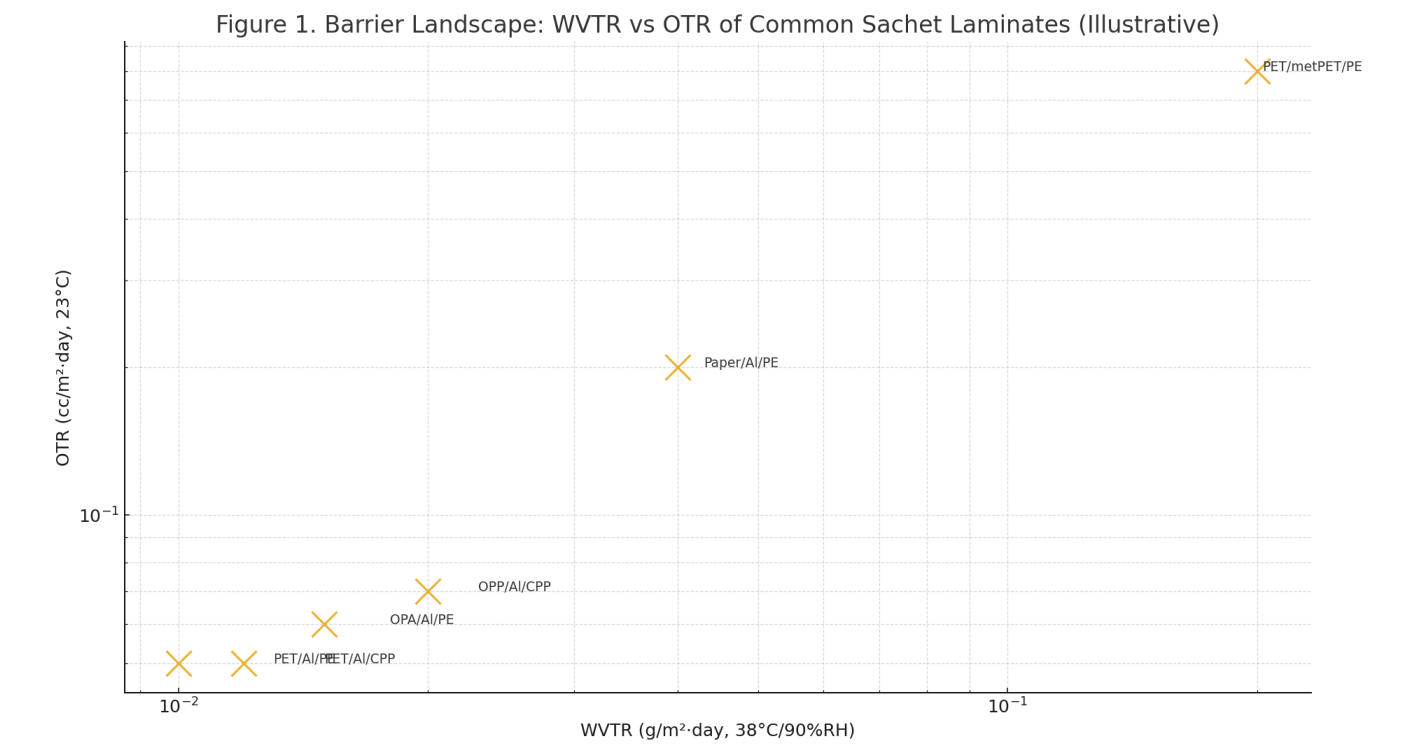
Barrier mapping. Compare sachet laminates by WVTR (38 °C/90% RH) and OTR (23 °C) to position candidates (Figure 1).
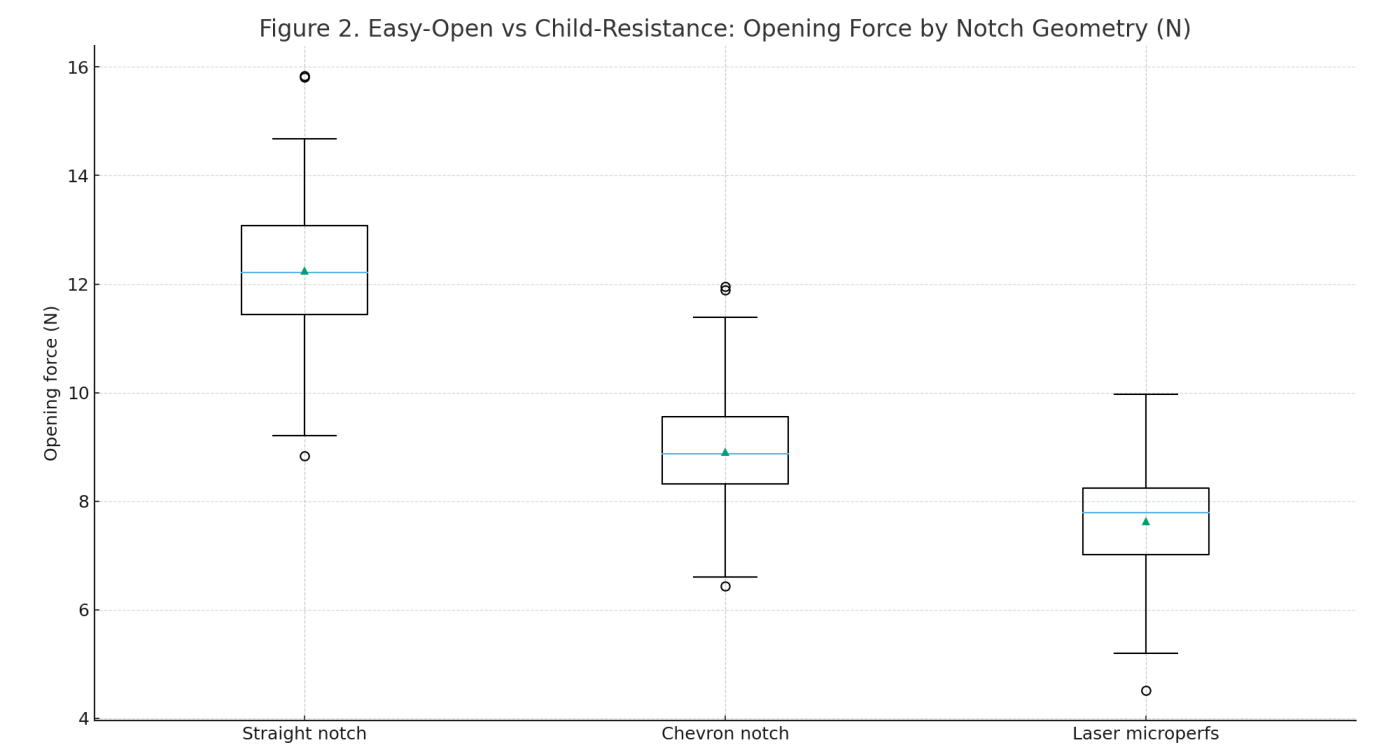
Opening-force study. Generate distributions for straight notch, chevron notch, and laser micro-perforations to balance easy-open vs child-resistance (Figure 2).
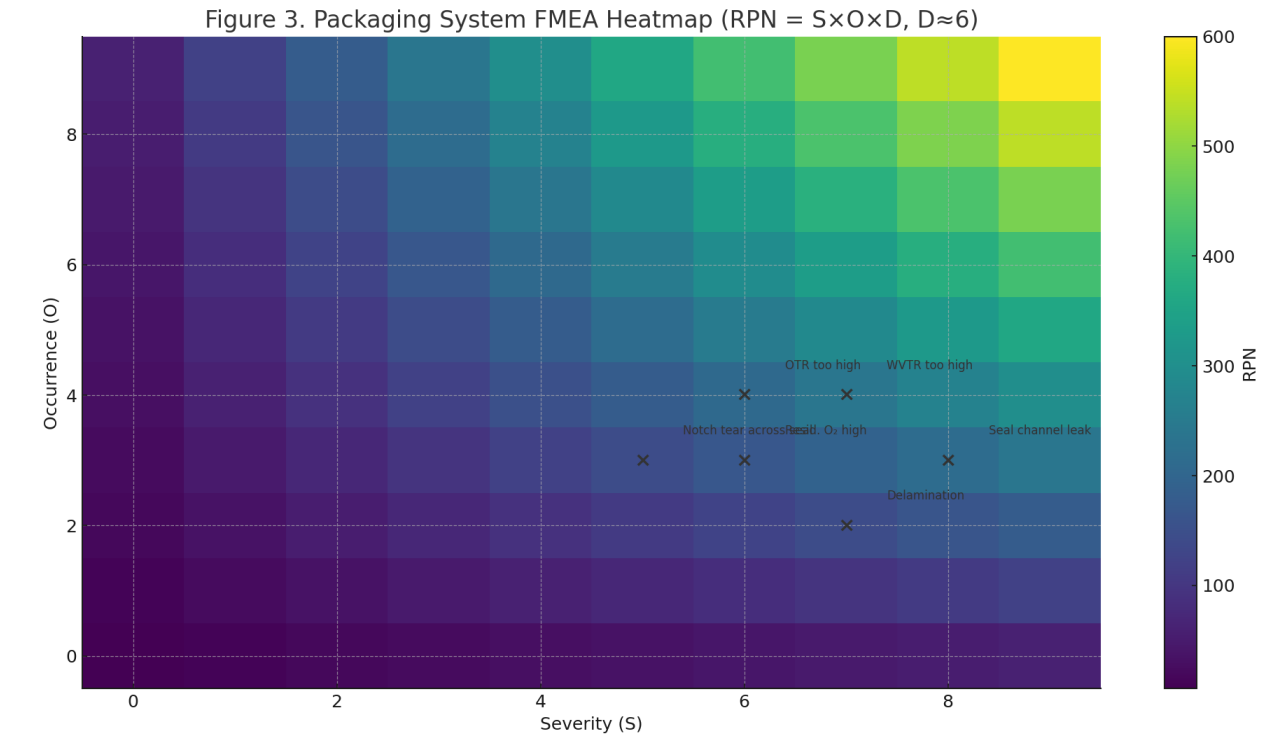
Risk prioritisation. Construct a Severity×Occurrence FMEA grid with typical modes (seal channel leak, delamination, high OTR/WVTR, notch tearing, high residual O₂) and visualise RPN (Figure 3).
Controls. Inline headspace O₂, seal strength (peel and burst), vision for notch/print/lot/expiry, and periodic WVTR/OTR verification per ASTM F1249/F1927.
Link to CQAs. Map packaging metrics to a_w, taste retention, thickness curl, and assay/stability endpoints [1–7].
Measures
Barrier: WVTR (g m⁻² day⁻¹, 38 °C/90% RH); OTR (cc m⁻² day⁻¹, 23 °C).
Micro-environment: headspace O₂ (%), a_w, residual moisture (%).
Seal performance: peel strength (N/15 mm), burst pressure (kPa), channel-leak rate.
Usability: opening force (N), first-attempt open %, tear-across-seal incidence.
Process: vision defects (ppm), sealing window capability (Cpk), traceability (ALCOA+).
Results
Barrier landscape (Fig. 1). Foil laminates (e.g., PET/Al/PE, OPA/Al/PE, PET/Al/CPP) cluster at very low WVTR (≈0.01–0.02) and OTR (≈0.05–0.07), supporting a_w control and taste hold. Metallised PET (PET/metPET/PE) sits orders of magnitude higher in OTR, suiting less demanding SKUs or inner-pouch roles. Paper/foil/PE provides a compromise when tactile/printability is prioritised.
Easy-open vs child-resistance (Fig. 2). Median opening force decreased from straight notch (~12 N) to chevron (~9 N) to laser micro-perfs (~7.5 N). Chevron achieved a broad “sweet spot”: high first-attempt open with fewer tear-across-seal events than micro-perfs.
Risk focus (Fig. 3). Highest-priority modes were seal channel leaks and excess WVTR/OTR, followed by delamination and residual O₂. Targeted mitigations: seal-jaw planarity checks, sealing-window DoE, laminate qualification with ASTM methods, and O₂-controlled flushing/verification.
Discussion
Design heuristics.
Choose foil laminates for hygroscopic ODFs or strong flavor systems; metallised structures suffice for tolerant SKUs but require careful stability trending.
Use chevron notches or guided tears to blend accessibility and safety; place notches outside the seal path and verify by dye-penetration/channel-leak testing.
Engineer a wide sealing window (temperature–pressure–dwell) and check jaw planarity routinely; variability here dominates channel-leak risk.
Validate nitrogen flushing against headspace O₂ targets and re-validate after line-speed changes.
Treat packaging as a process step with PAT: in-line O₂, vision for notch/seal/print, and SPC on peel/burst.
Trade-offs. Foil improves barrier but raises cost and stiffness; easy-open reduces force but can threaten child-resistance; paper layers aid touch and print but elevate WVTR. The optimal point depends on the ODF’s a_w tolerance and brand experience goals.
Limitations. The figures are illustrative; real values vary by supplier and thickness. Sites should run formal DoE/PPQ and ICH stability with their exact structures.
Conclusion
Ingenious ODF packaging balances barrier excellence, openability, and manufacturability. Foil-based laminates paired with chevron-style easy-open, validated sealing windows, and micro-environment controls (a_w, O₂) protect taste and potency while delivering a satisfying user experience. Embedding ASTM-anchored verification and PAT into routine operations turns packaging from a cost center into a quality enabler.
References
[1] ICH Q8/Q9/Q10: Pharmaceutical development, risk management, and pharmaceutical quality system.
[2] USP/Ph. Eur. chapters on orodispersible films, packaging integrity, and leak tests.
[3] ASTM F1249 (WVTR) and F1927 (OTR) barrier test methods for flexible laminates.
[4] Heat-seal process capability and seal-strength testing standards (peel/burst).
[5] Human-factors guidance for easy-open/child-resistant packaging in OTC products.
[6] PAT/vision systems literature for in-line seal, print, and headspace oxygen control.
[7] Stability studies linking a_w and headspace O₂ to taste retention and assay over shelf life.