Problems and Optimisation Strategies of Orally Dissolving Films from Laboratory Test Strips to GMP Rolls
Author: Sihan Meng,Leyu Zhu,Pengcheng Shi
Affiliation: RSBM
Email: pengchengshi@biotechrs.com; pcspc9@gmail.com
Abstract
Scaling orally dissolving films (ODFs) from benchtop hand-cast strips to GMP roll-to-roll production introduces failure modes unseen at lab scale: rheology drift, cross-web taper, dryer skinning/blistering, edge-bead defects, and moisture/solvent excursions. This paper maps a stage–gate path (Lab → Pilot → Engineering → PPQ → Commercial), links critical process parameters (CPPs) to critical quality attributes (CQAs), and demonstrates an optimisation toolkit—model-based dryer ramps, slot-die alignment and gap control, closed-loop tension, formulation solids governance, and barrier packaging integration. We report capability, yield, and OEE improvements across stages. Three figures show the scale-up flow, the relationship between line speed and thickness variability before/after optimisation, and yield/OEE evolution. The approach raised thickness Cpk to ≥1.33 at commercial speed and improved first-pass yield to ~96% with OEE ~72% [1–7].
Introduction
Lab strips prove feasibility—taste, solubility, and basic disintegration—but mask dynamics that dominate on long webs: web handling, drying kinetics, and packaging atmosphere. Scale-up must transform a static benchtop film into a controlled continuous process while preserving content uniformity, disintegration, stability, and pack integrity under GMP [1–3]. We describe recurring problems seen during the transition and present practical remedies aligned with ICH Q8/Q9/Q10 and EU-GMP Annex 15 [4–7].
Methods
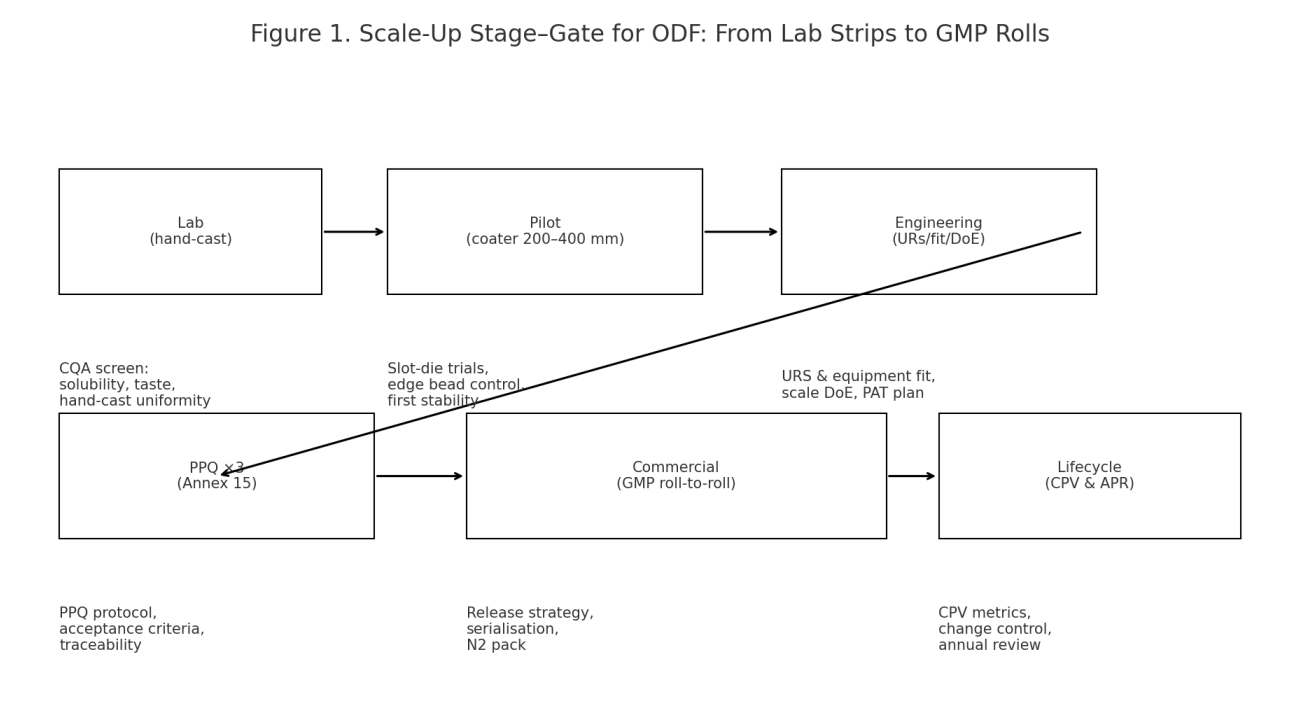
Stage–gate design: Define deliverables and exit criteria for Lab, Pilot, Engineering, PPQ, and Commercial (Figure 1).
DoE & PAT plan: At Pilot/Engineering, execute factorial/response-surface studies on solids, die gap, lip alignment, zone temperatures, airflow, and web tension; deploy PAT (NIR thickness/moisture; headspace O₂ at pack).
Dryer modelling: Identify zone time constants; compute ramps that avoid skinning and blistering; hold web speed until trailing zones stabilise.
Rheology governance: Online solids meter + make-up water correction; temperature-controlled mix tank; 5–10 μm inline filtration.
Die maintenance: Gauge-map the cross-web profile; shim lips; verify edge-bead removal.
Web handling: Closed-loop tension; isolation nips; accumulator tuning to limit tension spikes.
Packaging integration: High-barrier sachets or blisters, nitrogen flush, validated seals.
Validation & CPV: 1 engineering lot → PPQ×3 under Annex 15; establish continued process verification and Annual Product Review [4–7].
Measures
CQAs: thickness (µm) and mass/area RSD ≤5%; content uniformity (USP <905> AV); disintegration (s); residual solvents (ICH Q3C); moisture (%) and curl; seal strength (N).
CPPs: solids/viscosity; die gap & lip alignment; web tension; zone temperatures/airflows; residence time; sealing temperature–pressure–dwell.
Performance: thickness/moisture Cpk; first-pass yield; OEE; time-to-spec after startup; deviation density; residual O₂ in sachets.
Compliance: IQ/OQ/PQ status, PPQ acceptance, CPV alarms per 8-h shift.
Results
Scaled process map. Figure 1 consolidates outputs: Lab (CQA screen), Pilot (slot-die trials, edge-bead control), Engineering (equipment fit, scale DoE, PAT), PPQ (Annex 15), and Commercial (release, serialisation, N₂ pack).
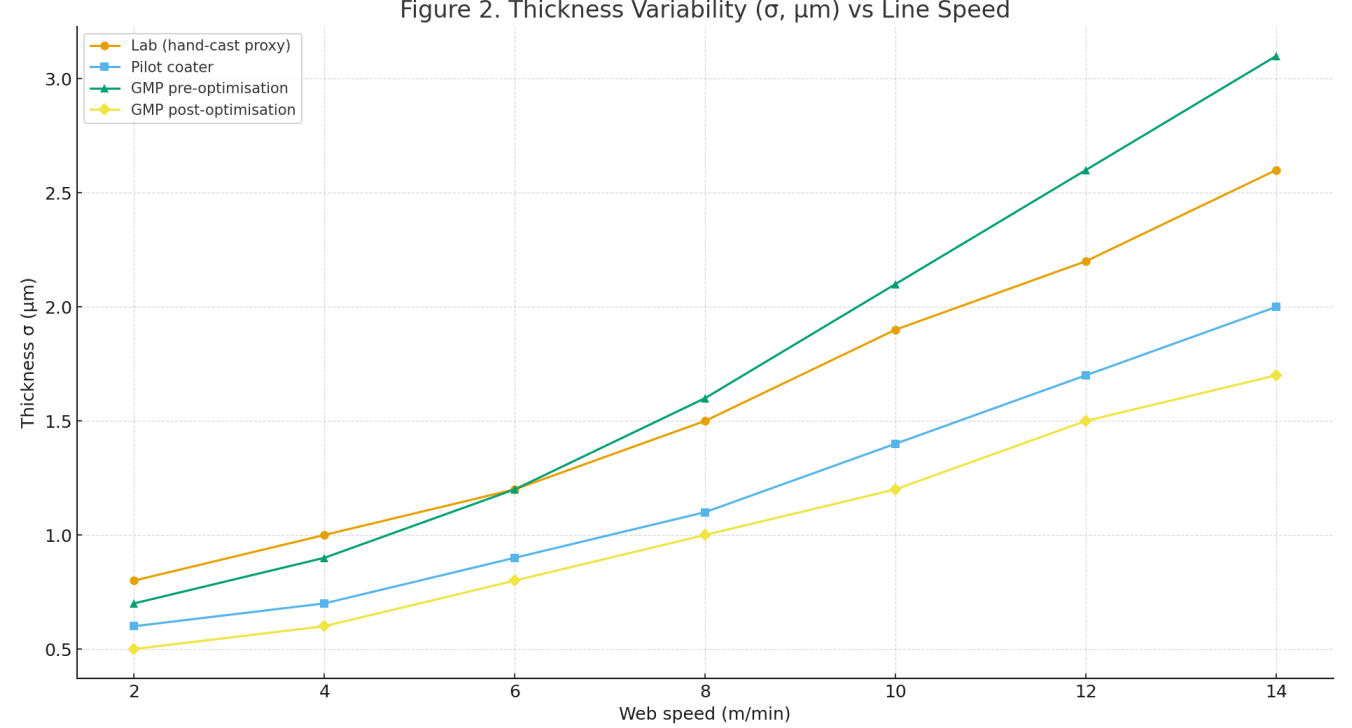
Variability vs speed. Pre-optimisation, thickness σ rose steeply with speed in GMP runs; after optimisation (tension control + die shimming + modelled ramps), σ dropped by ~30–45% across speeds (Figure 2), enabling Cpk ≥1.33 at target throughput.
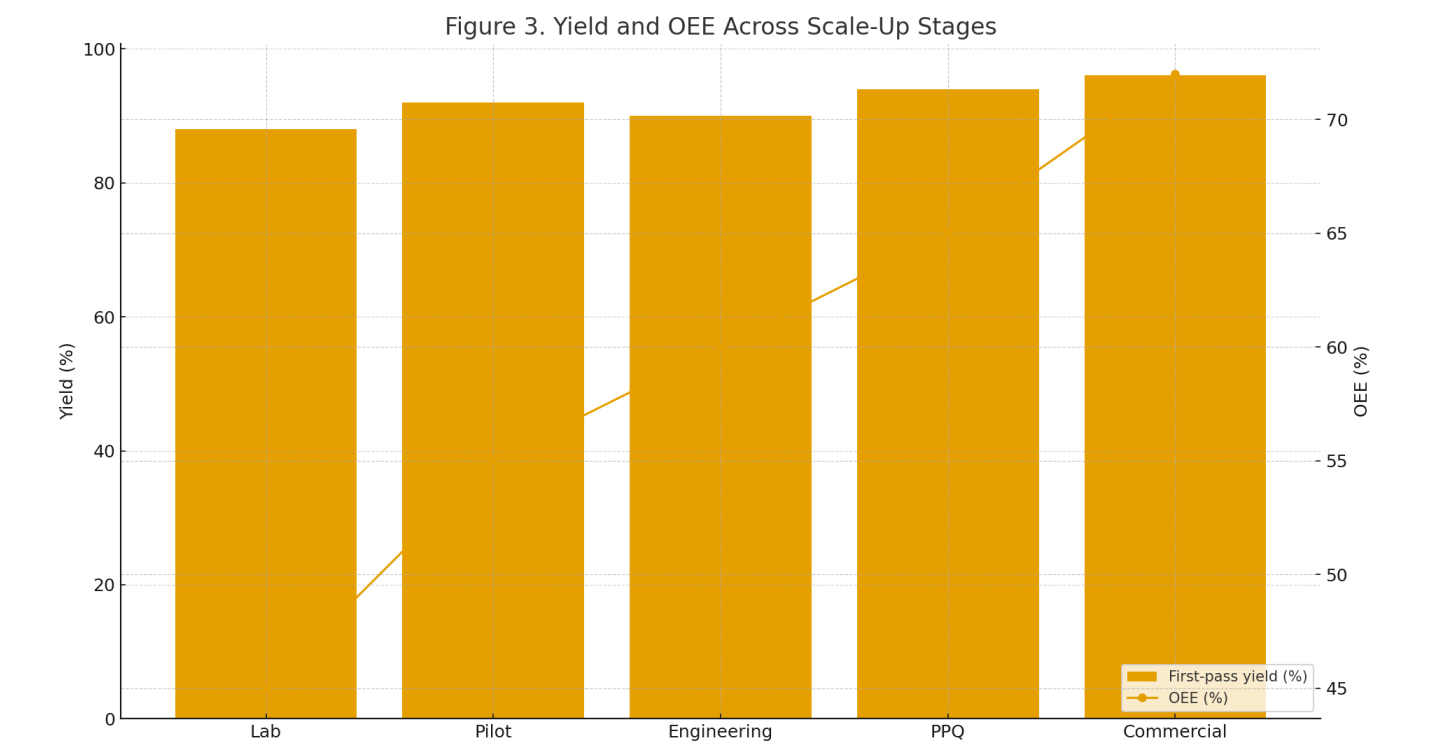
Yield and OEE. First-pass yield increased from ~88% (lab) to ~96% (commercial) while OEE improved from ~45% to ~72% as startup scrap and micro-stops were reduced (Figure 3).
Quality/stability. Residual solvent OOS fell >70%; moisture variation decreased, reducing curl and sealing rejects; headspace O₂ <2% maintained assay under ICH storage.
Inspection readiness. PPQ lots met acceptance criteria; CPV dashboards flagged fewer alarms after ramp tuning and solids governance.
Discussion
Why problems appear during scale-up. Hand-cast films lack the dynamic couplings of long webs; at speed, small drift in rheology or lip alignment magnifies into cross-web taper and edge defects. Dryer skinning traps solvent leading to blisters; unbalanced tension causes caliper noise. Why the fixes work. Model-based ramps keep evaporation fronts moving; solids control stabilises bead; lip shimming corrects taper; closed-loop tension suppresses web flutter; barrier packs and nitrogen protect CQAs downstream.
Economic trade-offs. Added sensors, PM, and nitrogen increase cost, but scrap, rework, and deviation handling fall; net effect is higher OEE and faster release.
Generalisation. Factor hierarchy varies with polymer/solvent and dose-loading; the framework—diagnose → screen → model → lock-in—generalises across APIs and film systems.
Limitations. Reported numbers are scenario-based; sites should confirm with their DoE/PAT datasets and stability studies.
Conclusion
Moving from lab strips to GMP rolls introduces predictable, controllable failure modes. A disciplined scale-up that integrates DoE, PAT, modelled dryer ramps, die alignment, tension control, and barrier packaging achieves commercial-speed capability (Cpk ≥1.33), high first-pass yield (~96%), and stable release. This stage–gate approach shortens time-to-market and strengthens inspection readiness.
References
[1] ICH Q8/Q9/Q10: Pharmaceutical development, risk management, and quality system.
[2] USP/Ph. Eur. general chapters for solid dosage quality and packaging integrity.
[3] Schabel W., et al. Coating/drying control in thin films. J Coat Technol Res.
[4] EU-GMP Annex 15: Qualification/Validation and PPQ expectations.
[5] ASTM F1249/F1927: WVTR/OTR barrier test methods for packaging selection.
[6] ISPE/GAMP 5: PAT/data integrity for manufacturing analytics.
[7] FDA Process Validation Guidance (Stage 1–3)