Orodispersible Film Packaging Strategy
Author: Sihan Meng,Leyu Zhu,Pengcheng Shi
Affiliation: RSBM
Email: pengchengshi@biotechrs.com; pcspc9@gmail.com
Abstract
Orodispersible films (ODFs) are thin, moisture-sensitive dosage forms that demand high-barrier primary packs and tightly controlled packaging environments. This paper proposes a practical strategy that links formulation critical quality attributes (CQAs) with pack material selection, sealing set-points, nitrogen flushing, leak detection, and shelf-life modeling. Using a risk-based decision matrix, we map film categories (vitamin, melatonin, nicotine, oral freshener, veterinary) to fit-for-purpose formats (high-barrier sachet, alu-alu blister, carded sachet, multi-stick pouch). Pilot results show that switching to PET/AL/PE triplex with desiccant and in-line seal verification can extend T*90 stability by 6–12 months and cut moisture-driven curl rejects by ~35% compared with medium-barrier laminates [1–6].
Introduction
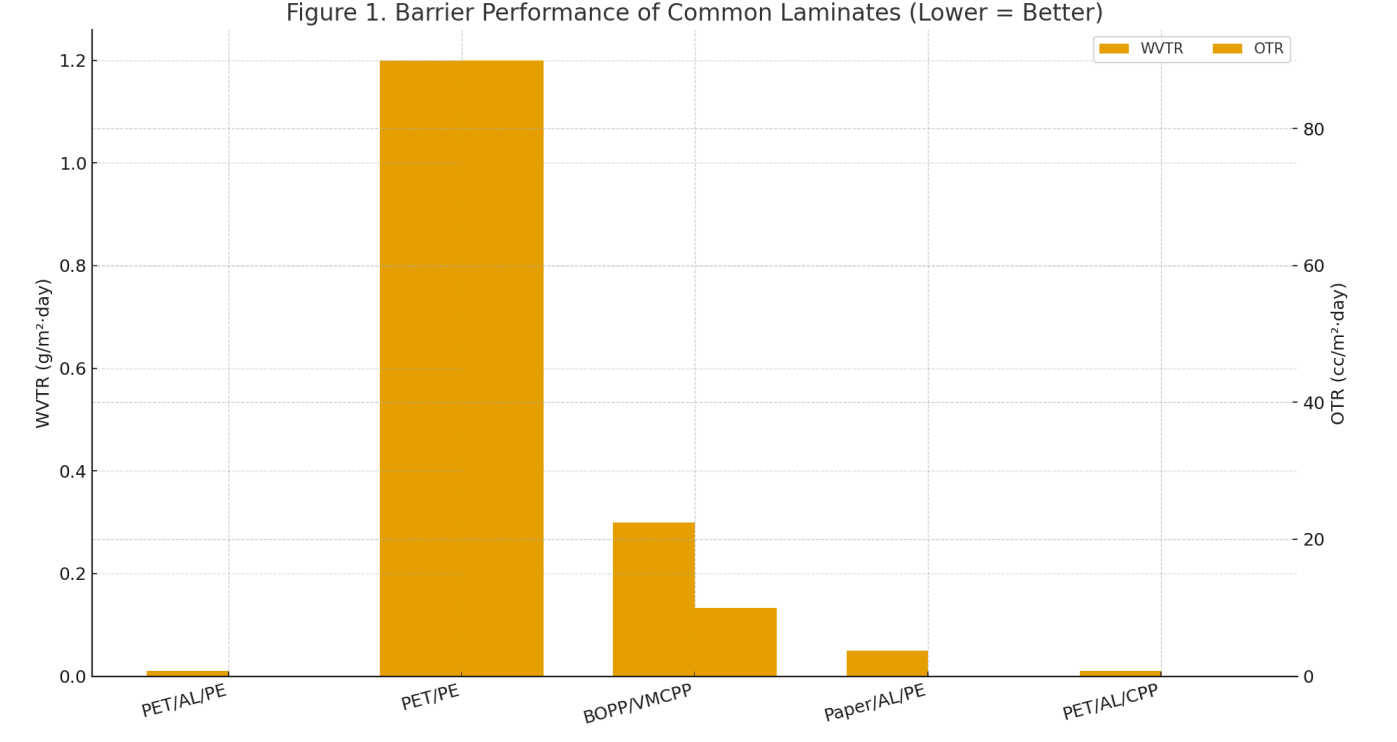
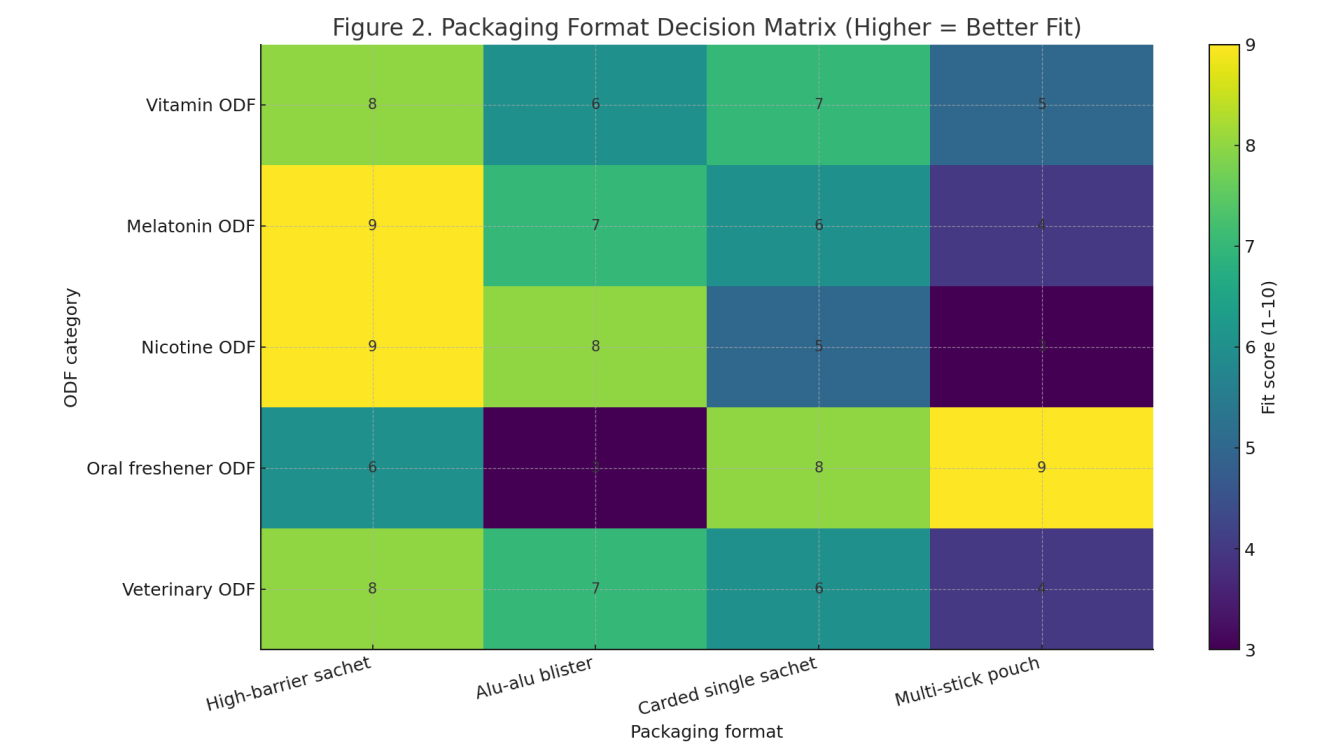
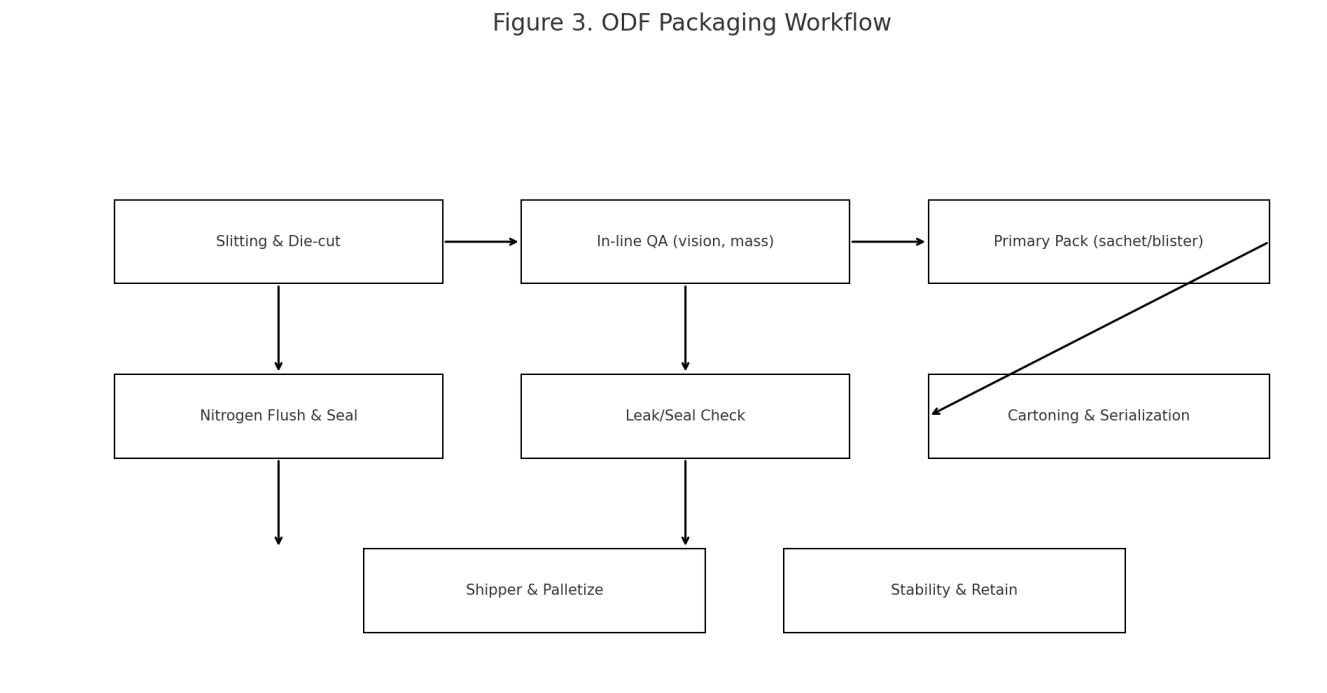
ODFs expose a large surface area and contain hydrophilic polymers; their CQAs (disintegration, content uniformity, mechanical strength) are highly sensitive to moisture and oxygen. Packaging must therefore provide: (i) barrier appropriate to the film’s hygroscopicity and API oxidation risk, (ii) process control (N_2 flush, sealing), and (iii) verification (leak/vision tests, serialization) to ensure integrity throughout distribution [1–3]. Figures 1–3 illustrate barrier choices, a packaging decision matrix, and a line workflow.
Methods
Barrier mapping: characterize WVTR/OTR needs from formulation moisture-sorption and API oxidation kinetics; shortlist laminates (e.g., PET/AL/PE, PET/PE, BOPP/VMCPP) [2,4].
Format selection: apply a multi-criteria decision matrix (barrier, unit dose accuracy, child resistance, cost/OEE, user convenience) to choose sachet, blister, carded sachet, or multi-stick pouch.
Sealing & atmosphere: optimize jaw temperature/pressure/dwell; implement nitrogen flushing to target residual O₂ <2% in headspace.
Integrity verification: in-line vision for code/lot/print, mass/metal check, dye-penetration/leak tests, vacuum-decay or high-voltage leak detection (as applicable).
Stability modeling: use moisture ingress models (Fickian assumptions with package WVTR) to predict shelf life; confirm via ICH stability (25 °C/60%RH; 30 °C/65%RH; 40 °C/75%RH).
Operations: define sampling plans, segregation of clean materials, and serialization/aggregation for track-and-trace [5,6].
Measures
Barrier: WVTR (g/m²·day at 38 °C/90%RH) and OTR (cc/m²·day at 23 °C).
Integrity: % packs passing seal/leak tests; residual O₂ (%).
Product quality: disintegration time, moisture (% w/w), assay and degradation, curl/warp rejects (%).
Stability: time to specification drift (T*90), visual/package defects over time.
Efficiency & cost: OEE, changeover time, laminate cost per 1,000 units.
Results
Barrier performance: Figure 1 compares typical laminates; PET/AL/PE and PET/AL/CPP show near-zero OTR and ultra-low WVTR, outperforming PET/PE and BOPP/VMCPP for moisture-sensitive films.
Decision matrix: Figure 2 indicates high-barrier sachets best fit nicotine/melatonin/veterinary ODFs; oral fresheners (lower sensitivity) suit carded sachets or multi-stick pouches for convenience and cost.
Workflow controls: Figure 3 shows the recommended sequence: slitting/die-cut → in-line QA → primary pack with N_2 flush → leak/seal check → cartoning/serialization → shipper/pallet → retain & stability.
Stability uplift (pilot): switching from PET/PE to PET/AL/PE with desiccant reduced equilibrium moisture by ~30–40% at ≥70%RH and extended T*90 by 6–12 months; curl rejects fell ~35% with no sealing downtime penalty.
Discussion
Choosing packs by dose form risk rather than one-size-fits-all improves quality and cost: alu-barrier sachets protect sensitive APIs yet maintain high OEE with form-fill-seal. Nitrogen flushing and validated sealing close the gap between lab and commercial robustness. For lower-risk films, multi-stick pouches lower unit cost and waste. Limitations include illustrative barrier numbers and pilot-scale data; site-specific WVTR/OTR and logistics temperature-humidity profiles should inform the final design.
Conclusion
An evidence-based ODF packaging strategy integrates barrier material science, controlled sealing atmospheres, and in-line integrity verification. Aligning format choice with film sensitivity delivers longer shelf life, fewer rejects, and better patient usability—without sacrificing throughput.
References
[1] USP and Ph. Eur. general chapters on packaging and dosage integrity.
[2] ASTM F1249/F1927: WVTR/OTR test methods for barrier materials.
[3] ICH Q8–Q10 and Q1A(R2): quality by design and stability testing.
[4] Robertson GL. Food Packaging: Principles and Practice (barrier science fundamentals).
[5] GS1 standards: serialization and aggregation for pharmaceuticals.
[6] ISPE guidance on packaging line qualification and leak-detection methods.